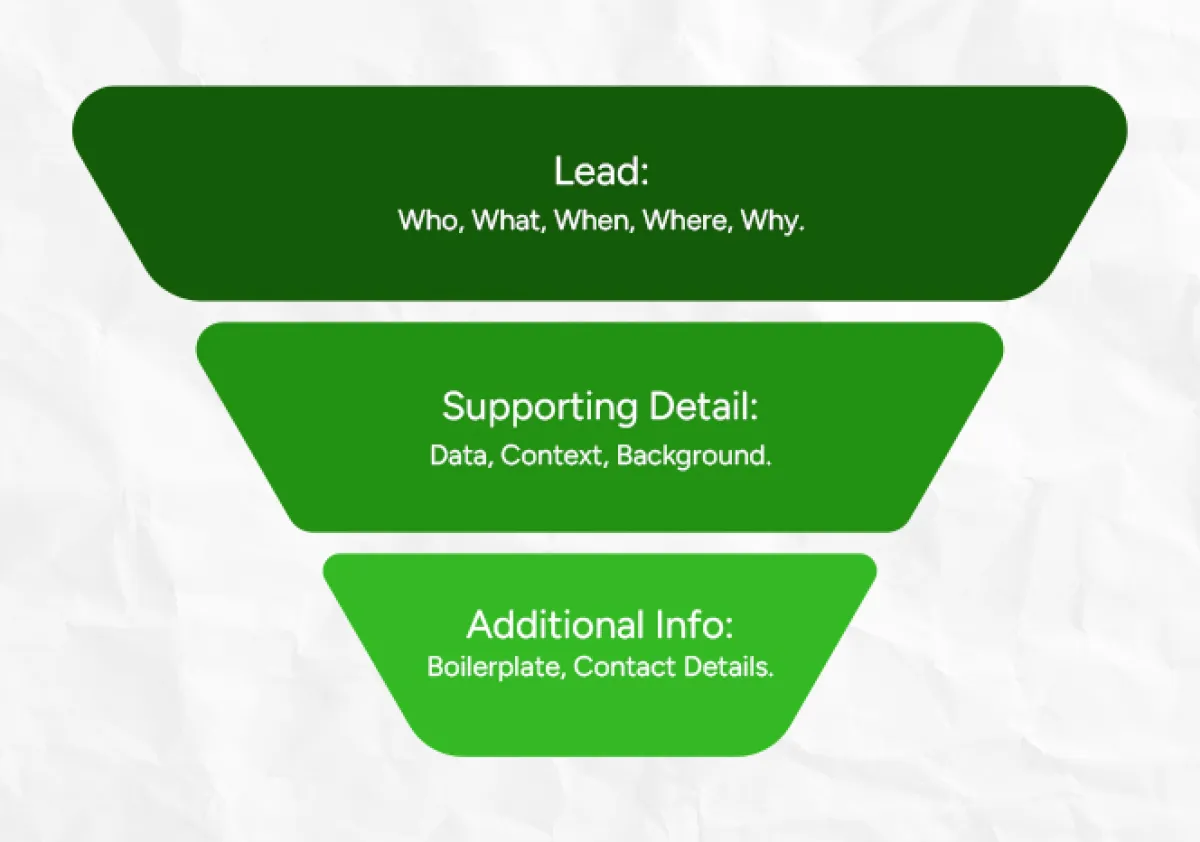
A press release is a structured news announcement distributed to journalists and media outlets to generate earned media coverage. When crafting one, following proven pr writing tips helps ensure your release leads with a newsworthy headline, follows the inverted pyramid, and answers who, what, when, where, and why in the opening paragraph. Close with a spokesperson quote, boilerplate, and media contact section.
Key Highlights:
A press release earns media coverage only when the news passes the editorial test before writing begins.
The inverted pyramid serves journalists and search engines for the same reason: both prioritize the most important information first.
Every element from headline to boilerplate has a defined function and skipping any of them costs credibility.
A well-crafted press release generates free publicity, builds journalist relationships, and drives target audience attention at no media buy cost.
FOR IMMEDIATE RELEASE and embargoed variations serve different distribution purposes and are not interchangeable.
Press release length varies by announcement type and has no single correct answer.
What Is a Press Release and Why Does It Matter?
A press release works because it gives a journalist everything needed to evaluate, assign, and report a story in a single document.
According to the Reuters Institute Digital News Report 2024, press releases remain among the most cited primary sources journalists use when developing stories. The format survives because it works. The execution is what determines whether yours gets covered or deleted.
The Editorial Test Every Release Must Pass First
Before a single word gets written, one question has to be answered honestly.
Would a journalist at a relevant publication cover this story without being asked?
If the answer is no, the writing does not matter. No amount of polish on a non-story will turn it into coverage. The editorial filter is not a journalism standard you work around. It is the entire logic of the channel.
Content that consistently passes this filter shares specific characteristics:
It announces something genuinely new: a product launch, a funding round, an acquisition, or a measurable outcome.
It connects to a trend or topic journalists are already actively covering in your industry.
It includes a named expert perspective that adds something a reporter could not find elsewhere.
It has a specific, concrete angle rather than a vague company update dressed up as news.
It serves the journalist's target audience, not just the company's marketing goals.
Types of Press Releases and When to Use Each
Not every announcement calls for the same approach. Understanding which type of PR announcement fits the situation is part of writing a press release well.
Type | Purpose | What to Lead With |
Product launch | Announce a new product or major update | Customer outcome, not product features |
Event press release | Promote upcoming or recap past events | Significance to the target audience |
Funding announcement | Share investment rounds with stakeholders | Amount, investor, and growth implication |
Merger and acquisition | Inform stakeholders about organizational changes | What it means for customers and operations |
Award press release | Highlight company recognition and credibility | Why the recognition matters to the industry |
Each type follows the same structural rules. What changes is the news angle and the opening frame. A compelling product launch announcement shifts from internal corporate language to news-driven storytelling that is specific, concise, and AI-friendly.
Press Release vs. News Release vs. Media Statement
A press release is a proactive announcement. A news release is the same document in institutional contexts. A media statement is reactive, issued in response to a journalist inquiry rather than to generate coverage.
The differences between a press release and a news release are worth understanding before choosing which format the situation calls for.
Press Release Format: Structure, Elements, and Standards
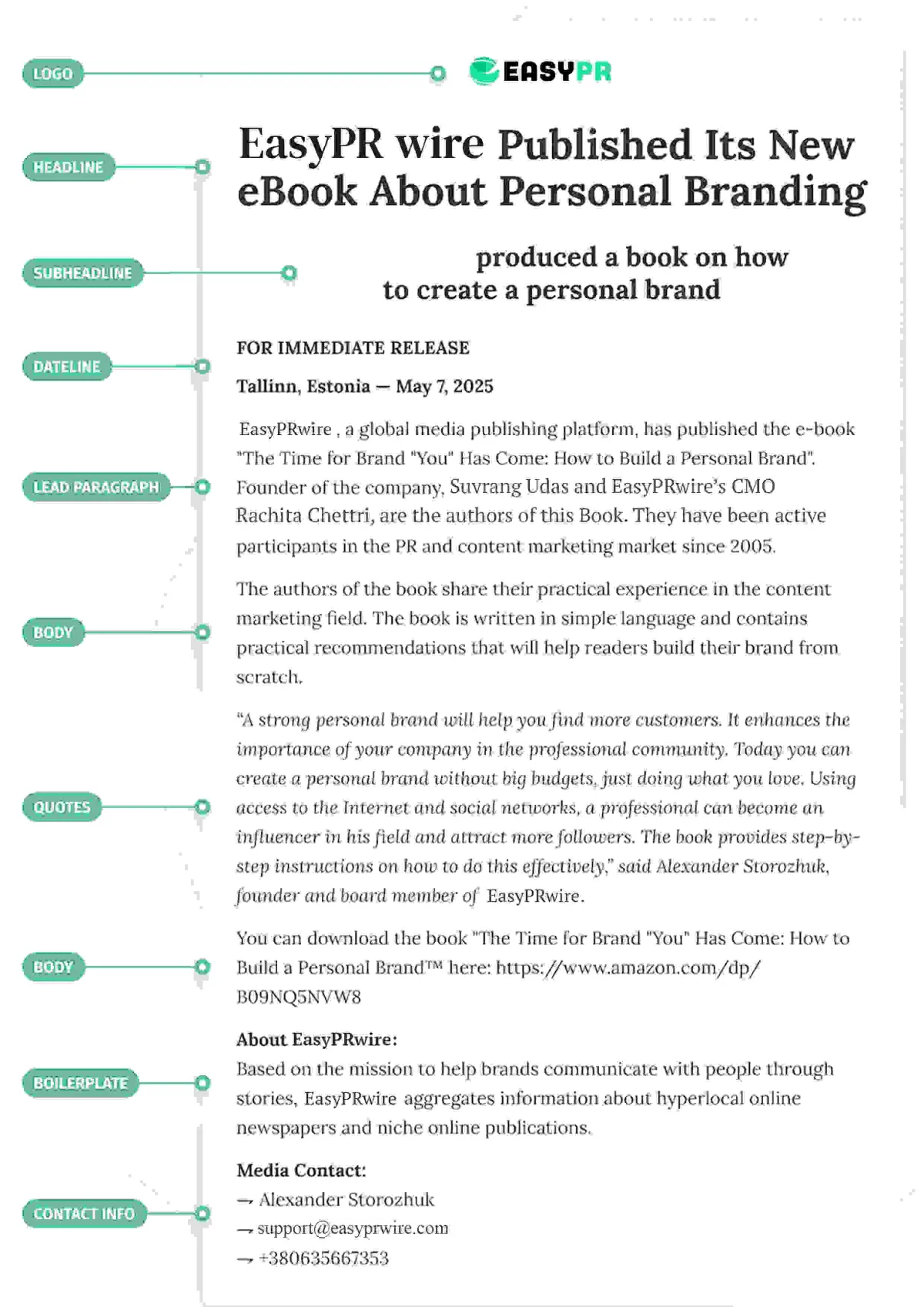
Press release format follows a fixed 10-element structure: release status line, headline, subheadline, dateline, lead paragraph, body, spokesperson quote, end mark, boilerplate, and media contact - ordered to match how journalists read and how search engines extract content.
To help you apply these guidelines, you can use the press release template below as a structural guide for your next announcement. The following press relea example illustrates how to effectively integrate each of these ten components into a cohesive, professional press release.
The Standard Press Release Format at a Glance
Element | Position | Purpose |
Release status line | Very top, left-aligned | Signals timing and availability |
Headline | Below release status | Captures attention, signals the story |
Subheadline (optional) | Below headline | Adds context, supports SEO |
Dateline | Opens lead paragraph | Establishes location and date |
Lead paragraph | First paragraph | Answers the five Ws |
Body paragraphs | Middle section | Supporting detail, data, context |
Spokesperson quote | Inside body | Adds authority and human perspective |
End mark | After body or after contact | Signals completion to editors |
Boilerplate | After end mark or end of document | About the company, E-E-A-T signal |
Media contact | Final section | Journalist follow-up information |
The essential elements of a press release each carry a specific job. Remove any one of them and the document loses something a journalist or search engine was relying on.
Every Press Release Element Explained: Headline to Contact Details
Release Status Line: FOR IMMEDIATE RELEASE and Its Variations
The release status line appears at the very top left and tells the journalist when the story is available to publish. There are three common variations:
FOR IMMEDIATE RELEASE: The standard. The story is cleared for publication the moment the journalist receives it. This is used in the vast majority of press releases.
EMBARGOED UNTIL: [Date and Time] - The journalist receives the release in advance but agrees not to publish until the specified date and time. Used for coordinated multi-outlet launches, earnings announcements, or major product reveals where timing across publications needs to align.
NOT FOR RELEASE UNTIL: [Date and Time] - A stricter version of the embargo. Used when the organization wants explicit written acknowledgment that the journalist has agreed to the hold date before sharing the content.
Most business press releases use FOR IMMEDIATE RELEASE. Embargoes are reserved for situations where the timing of the announcement across multiple journalists needs to be carefully controlled.
Headline
The headline carries more weight than any other part of the release. It determines whether a journalist keeps reading and whether search engines can categorize the content accurately. A strong PR headline is specific, concrete, and outcome-focused.
Weak headline: Local Tech Company Announces Exciting New Product Launch
Strong headline: Austin SaaS Startup Cuts Customer Onboarding Time by 60% With AI-Powered Platform
The second version gives a journalist a story. The first gives them nothing to work with. Understanding the full craft behind writing a compelling press release headline matters because the headline determines click-through rates across every syndicated version of the release. A bank of headline frameworks for different announcement types is worth having ready before you need them.
Subheadline
Optional but useful when the headline is tight on space. The subheadline adds one layer of supporting context, typically a secondary keyword or a clarifying detail the headline could not carry.
Dateline
The dateline opens the first paragraph and establishes where and when the news originates. Standard AP style: CITY, State Abbreviation, Month Day, Year. For example: NEW YORK, NY, May 19, 2026. It signals immediacy and geographic relevance to both journalists and wire services.
See the Full Guide: Dateline in Press Release
Lead Paragraph
The most important paragraph in the release. It answers the five Ws: who is making the announcement, what is being announced, when it is happening, where it applies, and why it matters. All of this within the first 50 to 80 words. If a journalist read only the lead paragraph and nothing else, they should have enough to decide whether the story is worth pursuing.
Body Paragraphs
The body expands on the lead in descending order of importance. Data, research, context, and background belong here. Each paragraph adds something new rather than restating what came before. Short paragraphs of two to three sentences work better than dense blocks. The tone stays factual, neutral, and free of promotional language throughout.
Spokesperson Quote
Every news release needs at least one attributed quote from a named individual with a complete title. A quote from "a company spokesperson" carries no authority. A quote without a name signals that no one is willing to own the statement, which is a credibility problem before the release reaches an editor's desk.
Quotes from named executives consistently outperform generic attribution; a Cision 2024 report found 72% of journalists say a compelling quote increases their likelihood of covering a story. That is why how to use quotes in press releases is worth studying as its own discipline.
"The quote is not decoration. It is the only part of a press release that carries a human voice. A named executive with a specific, forward-looking perspective gives a journalist something they cannot manufacture on their own. That is what turns a release into a source." - Michael Smart, Media Relations Coach and Founder, MichaelSMARTPR
End Mark: Placement Conventions
The end mark, typically three centered pound signs (###), signals to an editor that no more content follows. There are two accepted placement conventions:
After the body, before the boilerplate: The more common modern format. The ### signals the end of the news content. The boilerplate and contact details that follow are supplementary reference material rather than part of the story itself.
At the very end, after all contact details: An older convention still used by many organizations, particularly in corporate communications. It signals the end of the entire document rather than just the editorial content.
Both are professionally acceptable. The first convention is more common in digital press release distribution today. What is not acceptable is leaving the end entirely unmarked, which leaves editors wondering whether they received the complete document.
Some organizations also use "-END-" or "-30-" as alternatives. All carry the same meaning. The full guidance on how to end a press release correctly, including which format works best for different distribution scenarios, covers the practical differences between each approach.
Boilerplate
The boilerplate is the About Us section that closes every release. Most companies write it once and paste the same paragraph onto every release they ever send. That is a significant missed opportunity.
A well-written boilerplate is an E-E-A-T signal. It builds brand entity recognition quietly across every distribution. A strong boilerplate includes:
When the company was founded
What it does in specific, industry-relevant terms
Any notable recognition, certifications, or credentials
A link to the official website
Written like an objective description rather than a sales pitch, kept consistent across every release, and held to 50 to 100 words, it does more long-term credibility work than most brands ever give it credit for.
The full strategy behind writing an effective press release boilerplate is worth getting right once and applying consistently across every release you distribute.
Media Contact and Contact Details
The final section provides a named contact person, a direct email address, and ideally a phone number. This exists purely for journalist follow-up. When a reporter wants to verify a claim, request an interview, or get additional information, these contact details are where they look.
Ready to distribute your announcement?
Now that you understand the full structure and every element that belongs in a professional news release, the next step is getting it in front of the right journalists. EasyPRwire distributes to 200+ premium media outlets, guarantees Google News indexing within 24-48 hours, and gives you a real-time dashboard to track every pickup.
How to Write a Press Release Step by Step
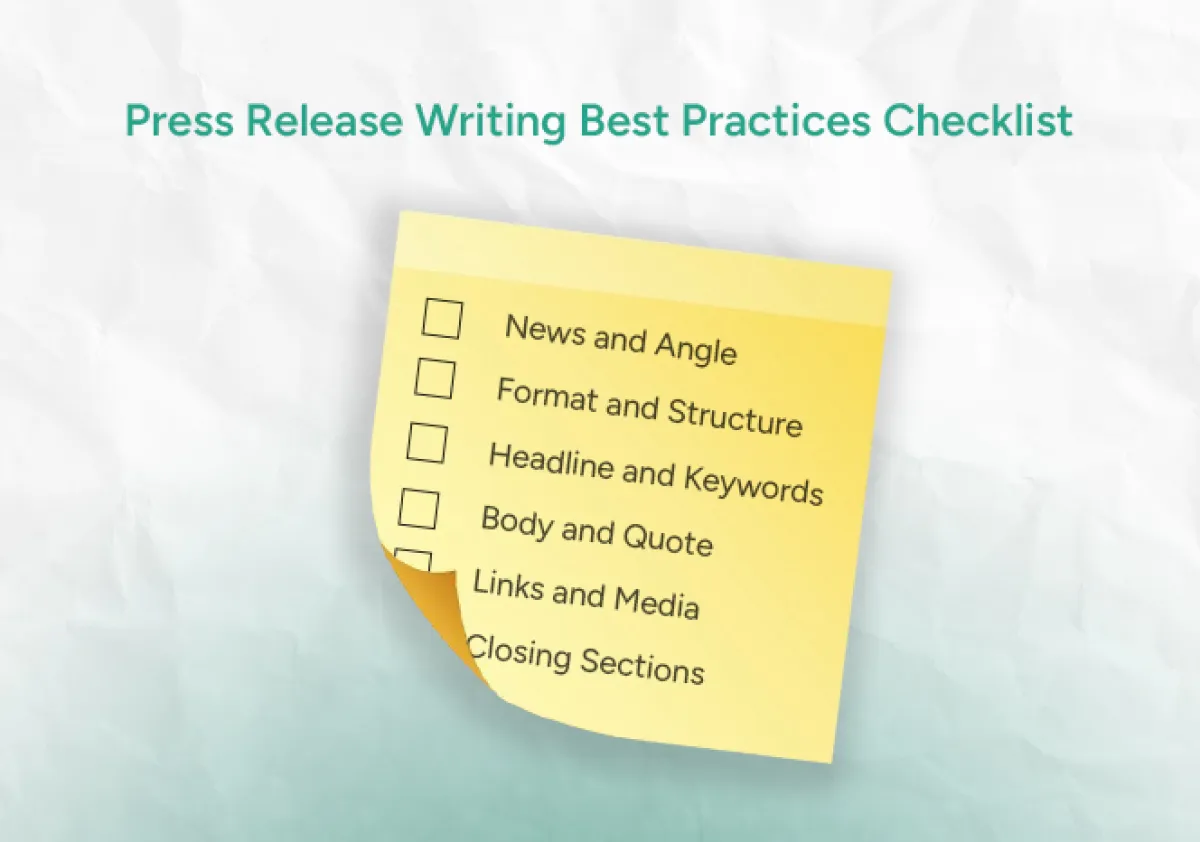
Writing a press release step by step means: finding the news angle first, writing the headline second, building the lead with the inverted pyramid, expanding the body with data and a quote, writing the boilerplate, and finalizing contact details before distribution.