
Press release SEO is the process of optimizing corporate announcements and distributing them through targeted channels to improve organic search rankings, build brand authority, and earn editorial links.
A modern strategy structures your news to satisfy both search algorithms and journalists simultaneously, getting real journalists to cover your story and earn editorial backlinks that no wire network can replicate.
Expert's Note: "The press releases that consistently earn editorial coverage share one trait, they lead with data journalists can't find anywhere else. That's what converts a distribution into a real backlink."
— EasyPRwire
KEY TAKEAWAYS
Press release backlinks from automated wire syndication no longer pass meaningful link equity. Their value is indirect: brand signals, entity recognition, and earned media.
The goal of distribution is journalist pickup, not syndication volume. One editorial dofollow link from a real publication outweighs a thousand nofollow wire copies.
Local businesses have a specific, underused press release playbook for building geographic relevance signals and ranking in city level searches.
Every campaign needs measurement: branded search volume, referral traffic, new backlinks, and keyword movement across 72 hour and 30 to 90 day windows.
What Is Press Release SEO, and Why Does It Still Matter in 2026?
Press release SEO is the strategic practice of optimizing and distributing newsworthy corporate announcements to improve organic rankings, earn authoritative backlinks, and build a trusted brand entity.
A modern press release SEO strategy targets both human journalists and search engine crawlers, structuring official news so it aligns with search intent, triggers entity validation, and satisfies technical indexing requirements.
To measure press release SEO impact accurately, stop counting raw backlinks. Modern press release search visibility is an integrated strategy that shapes how algorithms perceive your brand's overall authority.
Why Does SEO Press Release Matters in 2026?
In a search landscape flooded with AI content, press releases provide verified, primary source data that engines trust. They offer a direct line to authoritative syndicates, solidifying your brand’s digital footprint.
Validates Entities: Feeds clean data directly into search knowledge graphs.
Earns Tier 1 Media: Attracts high trust, contextual coverage from real journalists.
Signals EEAT: Delivers official, verifiable corporate proof to search crawlers.
Controls Brand SERPs: Dominates branded search results with positive news.
Speeds Indexation: Uses fast news wire crawling to index new brand assets.
Get Your Press Release in Front of the Right Journalists
EasyPRwire distributes your announcement to indexed, high authority networks that search engines trust, so your news gets crawled, covered, and credited.
How Google Indexes Press Releases?
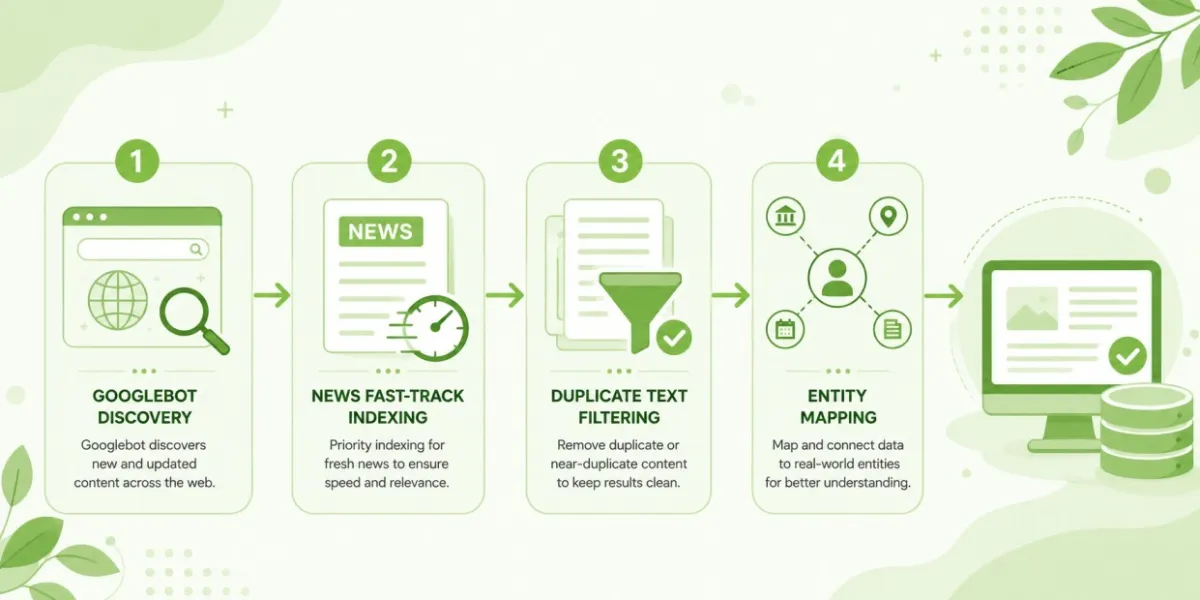
Google indexes press releases through a specialized news crawl pipeline, when your release lands on an indexed, high authority wire network, Googlebot achieves Google News indexation within minutes, bypasses standard crawl delays, clusters syndicated copies, selects one canonical URL, and extracts brand entities for the Knowledge Graph. When you deploy a digital PR campaign, search engines do not treat your content like a standard, slow crawled blog post.
1. The Fast Track News Crawl
When your release drops on an indexed, high authority network, Googlebot bypasses standard crawl delays and achieves Google News indexation within minutes, fast tracking placement into time-sensitive search carousels and news feeds.
2. The Canonicalization and Clustering Challenge
Wire syndication pushes identical copies across hundreds of subdomains. Google clusters these duplicates and surfaces a single "master" URL in results, which is why your internal publication order matters.
The Execution Risk: Syndicating before Google indexes your own domain copy can flag your site as duplicate, triggering a thin content penalty.
The Fix: Always publish to your newsroom first, confirm indexation in Search Console, then distribute externally.
3. Semantic Entity Extraction
Google's AI driven indexers extract defined entities, brand name, executive names, proprietary data, and geographic markers, and feed them into the Knowledge Graph. This validates your industry footprint and adjusts your topical authority across trusted media endpoints.
How to Write an SEO Optimized Press Release?
Writing a press release for SEO means balancing two audiences that want different things. Journalists want objective, newsworthy copy. Algorithms want structured, entity rich data. Write for bots, and editors reject you.
Write for editors only, and you miss ranking opportunities. The solution is the inverted pyramid structure: critical details at the top, supporting context in the middle, background last. Apply this journalism standard format with deliberate keyword placement and you get an asset that works for both audiences.
Press Release Keyword Research
Press release keyword research is not the same as evergreen content research. You are targeting a fundamentally different type of search intent.
News Query Keywords: High velocity, trending terms that appear in Google News carousels and Google Trends during breaking events, product launches, or industry shifts. These are the terms journalists use in their headlines right now.
Long Tail Keyword Press Release: Targets highly specific 3 to 5 word phrases that capture the exact niche of your announcement and face less competition in news results.
To bridge both, use semantic search principles. Instead of hammering a rigid keyword repeatedly, use conceptually related terms, industry synonyms, and structured entity data. This lets search engines grasp the contextual depth of your news while keeping the prose objective enough for an editor to run.
Press Release SEO Best Practices: Headline, Metadata, and Links
Press Release Headline Optimization: Keep your press release headline character count between 60 and 80 characters strictly to avoid SERP truncation. Place your primary keyword within the first five words. When pitching editors directly, remember that your distribution subject line also affects open rate, so keep it just as punchy and specific as your actual release headline.
Front Load the Lead Paragraph: Answer the five Ws (Who, What, Where, When, Why) in the first paragraph. Complete primary keyword placement naturally within the first 50 words.
Anchor Text Optimization: Limit links to a maximum of one or two hyperlinks. Avoid exact match commercial anchor text; it triggers spam filters. Use your brand name or descriptive contextual phrases instead.
Optimized Multimedia: Include at least one high resolution image or infographic with keyword rich descriptive alt text.
Consistent Corporate Boilerplate: Keep your company bio identical across every release. Consistent boilerplate text acts as a powerful entity validator, helping search engines confidently map your official digital footprint.
Press Release Meta Description: When hosting the release on your own newsroom, write a unique meta description of 140 to 160 characters containing a secondary keyword variation.
What Google Says About Press Release Links? (Nofollow, Sponsored, UGC)
According to Google Search Central guidelines on link schemes, syndicated content including press releases must use explicit link attributes to prevent algorithmic or manual penalty exposure:
Attribute | When to Use | SEO Impact |
rel="nofollow" | Standard syndicated wire links across all distribution endpoints. | Protects your site from penalty flags; search engines can still discover and crawl your brand's URLs. |
rel="sponsored" | Any paid wire distribution or media network placement. | Full compliance with Google's paid link policies per Google Search Central guidelines. |
rel="ugc" | User generated content: forum mentions, public comment boards. | Signals user created origin, protecting your main domain from association with unvetted content. |
Mass syndicated dofollow links with exact match anchors explicitly violate Google's link spam policies and can trigger a manual action. Confirm your wire service applies nofollow or sponsored attributes automatically, then focus on earning editorial dofollow links through journalist pickup.
48% of digital PR backlinks from editorial coverage carry a dofollow attribute, compared to only 33% for syndicated placements."
— Reboot Online, internal backlink analysis, 2024
Press Release Distribution for SEO: Choosing the Right Channels
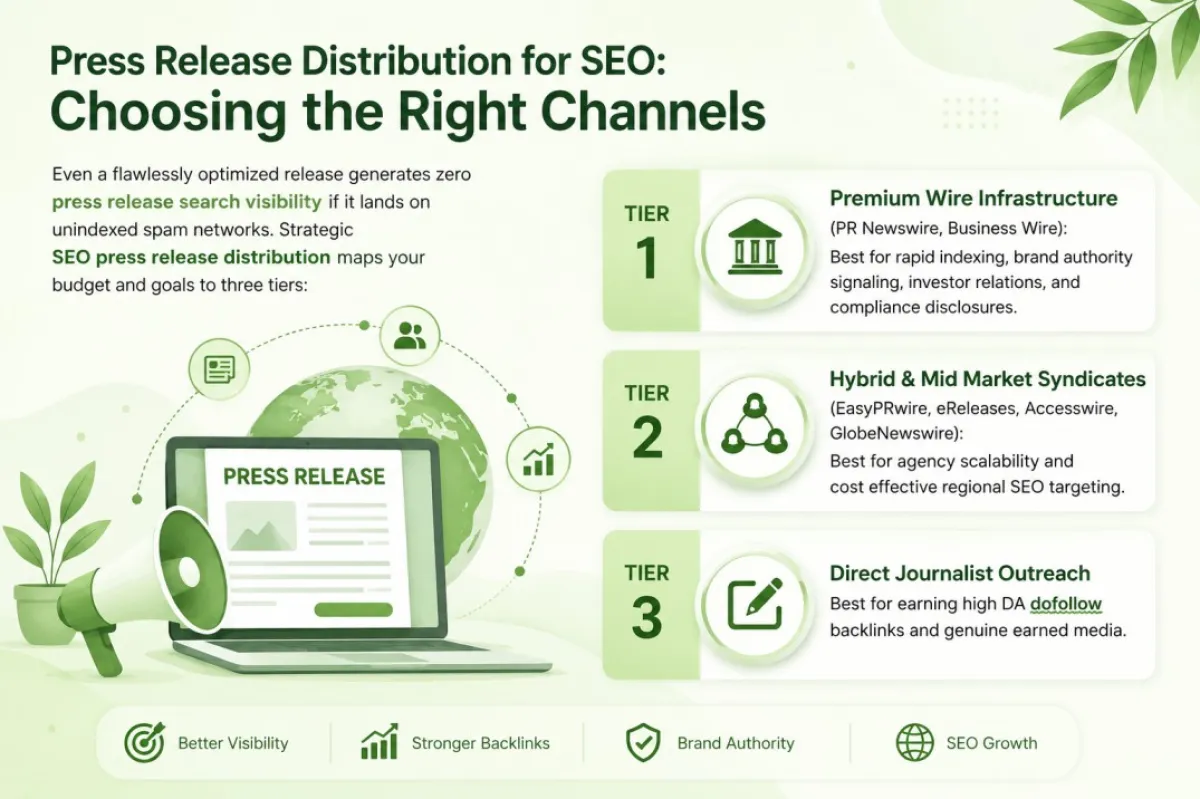
Even a flawlessly optimized release generates zero press release search visibility if it lands on unindexed spam networks. Strategic SEO press release distribution maps your budget and goals to three tiers:
Tier 1: Premium Wire Infrastructure (PR Newswire, Business Wire): Best for rapid indexing, brand authority signaling, investor relations, and compliance disclosures.
Tier 2: Hybrid & Mid Market Syndicates (EasyPRwire, eReleases, Accesswire, GlobeNewswire): Best for agency scalability and cost effective regional SEO targeting.
Tier 3: Direct Journalist Outreach: Best for earning high DA dofollow backlinks and genuine earned media. When pitching major announcements or exclusive research ahead of time, advance outreach often operates under a strict news embargo to give reporters adequate time to review original data and prepare full editorial coverage.
Not Sure Which Distribution Network Fits Your Goals?
From local geo targeted outlets to national wire networks, find the exact distribution sites that match your industry, audience, and SEO objectives.
Press Releases as an Off Page SEO Tool
Press release off page SEO value is broader than most marketers realize. An optimized announcement is not just a link asset, it injects entity data, trusted citations, and contextual signals into your broader marketing ecosystem.
The causal chain: an optimized release reaches targeted journalists, earns media coverage, generates authoritative backlinks and brand citations, and produces a measurable lift in domain authority and topical rankings.
How Press Releases Generate SEO Backlinks: 3 Types
The press release SEO backlink mix from a single campaign spans three distinct categories, each with a different SEO weight:
Type 1: Syndication Links
Automated links generated when wire services push your copy across their partner networks. These syndication links nearly universally carry nofollow or sponsored tags. Individual link equity press release value is low; Google is good at identifying duplicate syndicated text, but its collective value is an immediate, indexable footprint of corporate activity that establishes temporal brand relevance.
48.6% of SEO professionals consider digital PR the most effective link building tactic. Source: Seomatic
Type 2: Journalist Pickup Links
The ultimate goal. When an editor uses your data or quotes to write an original article, the resulting earned backlinks from media carry standard dofollow attributes. In the dofollow vs nofollow backlink debate, these editorial links are unambiguously the gold standard, they pass substantial PageRank and contextual trust directly to your core domains and drive real ranking improvements for competitive commercial terms.
Type 3: Unlinked Brand Mentions
Journalists frequently cite your company without including a hyperlink. No HTML means no direct PageRank flow, but do not write these off. Modern semantic models heavily weigh brand mentions to map market entities. Google reads unlinked text, associates it with your domain, and uses that data to build your industry footprint.
Pro tip “convert mentions to links”: When a high authority site publishes an unlinked mention, email the author within 24 hours: "Thank you for referencing our research in your piece on [Topic]. Would you consider adding a link to the full resource page?" This converts at a high rate because the journalist has already validated your content as newsworthy.
Press Releases and E-E-A-T: Building Authority Through Media Coverage
Beyond link equity, press releases are a serious E-E-A-T differentiator. The Google Quality Rater Guidelines instruct evaluators to look for independent, third party evidence when assessing a site's reputation, news articles, Wikipedia pages, professional societies, and peer reviewed papers.
When reputable publications consistently reference your company, algorithms read those citations as explicit verification of authority, mapping your brand into the Knowledge Graph with greater confidence and lifting your competitive equity broadly.
Press Releases for Local SEO: Dominating Geographic Queries
Most local businesses exhaust their off page budget on directories and citations. These are necessary baselines, but they rarely differentiate you from competitors. A targeted local press release strategy is one of the most underused tactics in local search marketing, and the opportunity gap is real.
Securing placements on authoritative local news outlets creates explicit geo relevance signals. Combine a local news placement with exact NAP citations and geo-specific content, and you get a meaningful boost in Map Pack prominence.
NAP Consistency: The Non Negotiable Foundation
Every announcement must include your boilerplate contact block with NAP citations (Name, Address, Phone Number) that match your Google Business Profile exactly, down to abbreviations and suite number formatting. If your Business Profile lists "123 Main St, Suite B" but your releases use "123 Main Street, No. 2," search algorithms struggle to cross reference the data. Mismatched details quietly erode your Map Pack visibility over time.
Getting Into Local Google News Results
Use an explicit dateline: Open your lead paragraph with a geographic dateline (e.g., Austin, TX — May 2026). This anchors the story geographically for indexation bots.
Pitch hyper local contacts: Filter your outreach for regional editors who cover neighborhood economies. A pick up from a city specific outlet carries more local ranking weight than a national wire placement with no geographic anchor.
Use geo targeted press release framing: Integrate location identifiers naturally into the news context, the specific neighborhood your new location serves, the local organizations you are partnering with, the regional data your survey covers.
Local Press Release Topic Ideas That Actually Get Coverage
Regional editors get flooded with corporate filler. These topic categories consistently earn legitimate pickup:
Community Involvement & Newsworthy Events
Charity partnerships: a long term donation matching program with a prominent local nonprofit.
Event sponsorships: serving as the anchor sponsor for a municipal festival, youth sports league, or charity run.
Volunteer initiatives: a neighborhood restoration or cleanup project led by your corporate team.
Business Milestones & Growth
New executive hires with a local industry profile or community connection.
Significant anniversaries (10, 25, or 50 years of service to the city).
Fleet or team expansion tied explicitly to growing consumer demand in specific zip codes.
Local Data & Research
Regional industry news via neighborhood market reports: original pricing, hiring, or real estate trend data across specific local areas.
City wide consumer surveys revealing how local residents are reacting to regional economic developments.
Corporate Recognitions & Facility Updates
Regional awards, top workplace rankings, or prestigious local business list inclusions.
Grand openings or major eco friendly facility upgrades, strong visual story hooks for local TV and print.
Measuring Press Release SEO Performance
Most campaign ROI reports are inflated by automated wire impression estimates. To properly measure press release impact SEO value, you need a data framework tied to real press release SEO metrics, segmented across two phases.
Phase 1 — Immediate Metrics (Within 72 Hours)
Audit technical indexation: Run five to ten specific placement URLs through Google Search Console URL Inspection to verify clean crawler access.
Track media pickup count: Record the distinct editorial networks and news portals that published original coverage, not syndication copies.
Configure referral traffic attribution: Tag every embedded link with custom UTM parameters (e.g., utm_source=pr-wire). This gives you clean press release tracking data in your analytics platform, isolating the exact visitor volume from each distribution network.
Phase 2 — Ongoing Metrics (30 to 90 Days)
Branded search volume: Monitor lifts in users searching your exact company name. This is the most overlooked signal in PR analytics and arguably the most valuable.
High value referral traffic: Measure users arriving from real editorial articles written by journalists who covered your story, not from wire syndication endpoints.
New backlink acquisition: Use Ahrefs or SEMrush to track organic dofollow backlinks earned from journalists referencing your announcement.
Around 7.83% of digital PR backlinks carry a DR of 90 or above, versus 1.2% for standard link building. Source: Reboot Online
Targeted keyword movement: Evaluate ranking positions for the primary news query keywords and long-tail terms you optimized in the release text.
Why Branded Search Volume Is the Secret SEO Signal?
When authoritative coverage runs, many readers skip the link, they open a new tab and search your brand name directly. That surge in branded search volume triggers a feedback loop. Algorithms interpret the correlation between third party media mentions and a spike in brand name searches as an explicit signal of growing user trust.
This is entity recognition Google builds on: validated references accumulate, your brand gets mapped into the Google Knowledge Graph with greater confidence, and the algorithm lifts your site's competitive equity broadly.
The connection between brand awareness and rankings is measurable, a sustained branded search volume increase after a press campaign is one of the clearest indicators of real SEO momentum.
Common Press Release SEO Mistakes and How to Avoid Them
Executed poorly, a press release can actively trigger algorithmic red flags. Here are the eight most common press release SEO mistakes:
Keyword stuffing in the headline: Forcing multiple search terms into your title creates a spam signal. Use one primary keyword naturally within the first five words, headline under 80 characters.
Overusing exact match anchor text: Linking commercial terms across automated endpoints mimics black hat link schemes. Use your brand name, URL, or natural descriptive phrases instead.
Distributing to spammy networks: Cheap, unindexed wire services associate your domain with low quality scraper hubs. Spend on platforms with proven Google News indexation.
Writing about non-newsworthy topics: Internal events no one outside your office cares about result in zero journalist pickup. Anchor every announcement to proprietary data, major expansions, or novel product launches.
Skipping multimedia assets: Text only submissions get filtered out by news portals. Embed at least one high resolution image with keyword rich alt text.
Failing to host a canonical version first: Syndicating before your newsroom is indexed can trigger a thin content penalty. Publish to your site, confirm indexation, then deploy to wire.
Over-relying on unedited AI templates: Robotic copy flags as spam. Use AI for outlines, then inject real executive quotes, original insights, and brand voice.
Writing for bots instead of journalists: Over optimized copy gets rejected by editors. Write as objective journalism using the inverted pyramid structure, optimization second.
When NOT to Use a Press Release? 5 Point Newsworthiness Scorecard
Over distributing trivial updates burns media relationships and signals low value noise to Google News bots. Before any campaign, pass your announcement through this check. If you cannot get at least three "Yes" answers, publish it as a blog post instead:
Immediate timeliness: Is this happening now, or tied to a trending, time sensitive development?
Clear human impact: Does this event directly alter things for your customers, community, or market?
Original data or insights: Are you sharing proprietary research or perspectives unavailable anywhere else?
Major organizational growth: Does this mark a structural milestone, new location, substantial tech expansion, or major hire?
Regional relevance: Does the story carry authentic relevance for the geographic or niche audiences you target?
Crawlers learn your newsroom's quality baseline over time. A history of editorial grade announcements trains bots to treat new submissions as trustworthy, a history of spam trains them to ignore everything you send.
Start Building Search Authority Without Enterprise Budgets
EasyPRwire offers scalable press release distribution plans for businesses of every size, transparent pricing, no hidden fees, and real indexation.
Conclusion: Building a Press Release SEO Program That Lasts
Press release SEO in 2026 is about building a compounding brand presence that algorithms treat as genuinely authoritative. The value is in brand signals, entity recognition, and earned editorial coverage, not syndication volume. One dofollow editorial link outranks a thousand nofollow wire copies. Execute with a newsworthy story, proper link attributes, and disciplined measurement.
Frequently Asked Questions
What is an SEO press release?
An SEO press release is a newsworthy corporate announcement optimized with strategic keywords, proper link attributes, and structured formatting to satisfy both search engine crawlers and human journalists with the goal of improving organic rankings, earning authoritative backlinks, and building brand entity recognition.
Do press releases still help SEO in 2026?
Yes, when executed correctly. The old link volume game is dead, but press releases still build brand authority, trigger entity recognition in Google's Knowledge Graph, and most importantly, earn editorial dofollow backlinks when journalists pick up your story.
Do press release links count as backlinks?
Wire syndication links are tagged nofollow or sponsored, so they pass no direct PageRank. The real SEO value comes from journalist pickup: when a real publication covers your story, that editorial dofollow link carries genuine ranking weight.
How often should I distribute press releases for SEO?
Quality over frequency. Three to four well timed releases per year, tied to genuine news events, outperform monthly blasts with thin content. Over distributing non newsworthy updates also trains Google's crawlers to treat your newsroom as low quality.
What makes a press release newsworthy enough for SEO?
It needs at least one of these: proprietary data or original research, a major business milestone, a significant product launch, a notable hire, or genuine community impact. If the announcement only matters internally, publish it as a blog post instead.
Should I host the press release on my own website first?
Yes, always. Publish to your own newsroom first and confirm Google has indexed it before syndicating to wire services. Syndicating before your own canonical URL is indexed can trigger a thin content issue on your site.


