
The best press release email subject line states the news in plain language, under 60 characters, with one proof point. That's the whole formula. Journalists get 200+ pitches a day and delete most of them in under three seconds, not because the stories are bad, but because the subject lines give them no reason to open.
In this guide, we have covered the six formulas that work, 25 real format examples organized by use case, and the patterns that get you filtered before a journalist ever sees your release.
Why the Subject Line Determines If Your PR Gets Read?
Most press releases never get read, not because they're badly written, but because the email never got opened. The average pitch to coverage rate sits below 3%, and the subject line is usually where that failure happens.
The average email open rate across all industries is 43.46% in 2025, up from 42.35% in 2024. Source: Mailer Lite
Journalists aren't reading subject lines. They're scanning. Gmail cuts previews off around 60 characters on desktop; on mobile it's closer to 40. If your news isn't obvious in the first few words, the email's gone.
According to Muck Rack's State of Journalism 2024, which surveyed 1,106 journalists in Q1 2024, 46% of journalists receive six or more pitches every single workday. This is a more precise, sourced replacement for the vague "200+ pitches a day" claim.
Reporters work across multiple beats, file against hard deadlines, and check email on their phones between interviews. A subject line that requires any mental effort to decode doesn't get decoded, it gets deleted.
This is why a press release with a strong headline, a sharp lede, and genuine news value can still go nowhere. If the subject line fails, none of that work matters. When you write a press release worth pitching, the subject line is the door. Your release is what's behind it.
The Formula for a High Open Rate Press Release Subject Line
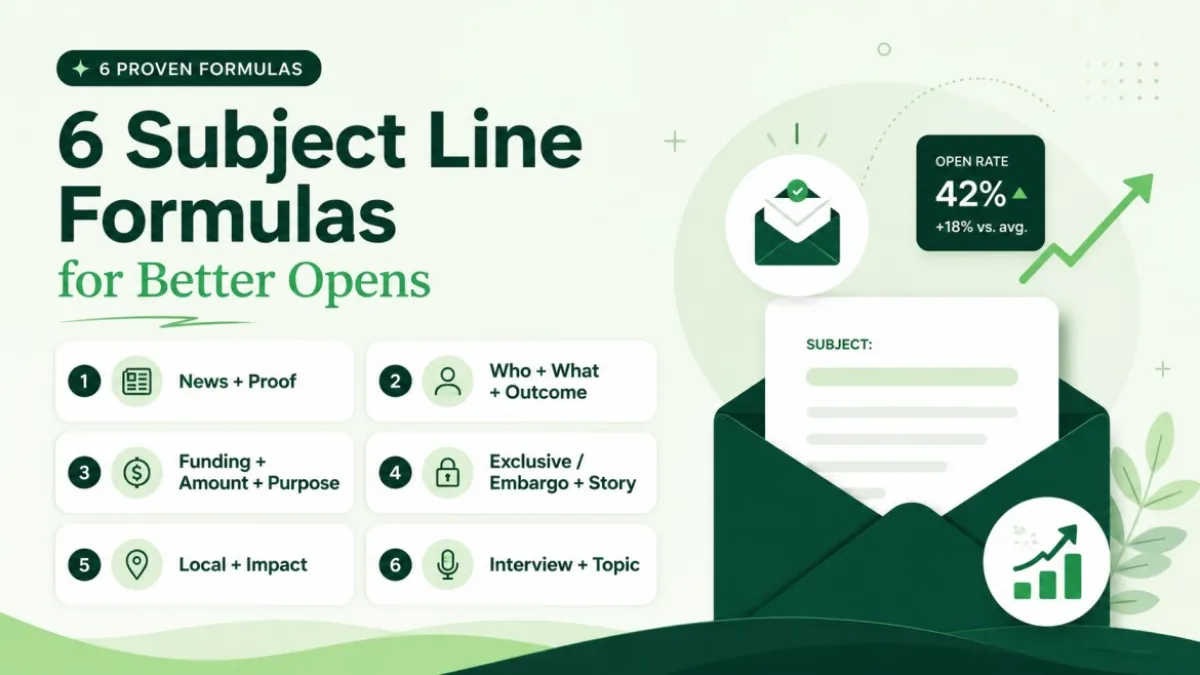
Every subject line that consistently earns opens follows one of six formulas. Incorporating these proven press release writing tips into your email pitch strategy ensures your release gets noticed in a crowded inbox. Pick the formula that fits your announcement and fill in the details:
[Label] + News + Proof: [Data] Survey: checkout abandonment up 12%
Who + What + Outcome: Acme cuts payment processing time by 30%
[Funding] + Amount + Purpose: [Funding] Acme raises $8M to expand into Europe
[Exclusive/Embargo] + Story: Exclusive: first look at new fraud detection model
[Local] + Impact: [Local] New plant adds 200 jobs in Austin
[Interview] + Who + Topic: [Interview] CEO available on new FTC ruling
The rules that apply across all six: stay under 60 characters, lead with the news not the brand, use one bracket at most, and put a number or named entity in wherever the story allows it. Numbers earn trust fast, "raises $8M" is concrete and scannable in a way that "secures significant investment" never is.
The formula doesn't change whether you're managing a startup press release for a seed round announcement or running a fintech PR distribution for a new payments product. The news changes. The structure doesn't.
Last thing on formulas: the subject line needs to match your press release headline. If a journalist opens the email and the release covers something different from what the subject line implied, you've lost their trust, and usually their attention for every pitch that comes after.
Expert Opinion: "Most press releases don't fail in the writing, they fail in the inbox. You can have the best story of the week and still get deleted in three seconds if your subject line doesn't tell a journalist exactly why it matters to their readers."
— EasyPRwire Editorial Team
25 Proven Subject Line Examples by Industry and Use Case
These are real format examples you can adapt directly. Each follows one of the formulas above.
Product Launch (5 examples)
Lead with what's new or different for the reader, not for the company. A SaaS press release distribution pitch for a new feature needs to answer "so what?" before the journalist even opens the email.
[Launch] New API cuts settlement time by 30%
[Product] First AI powered fraud detection for SMB payments
Acme introduces same day payout tool for freelancers
New inventory app helps retailers cut stockouts by 22%
[Launch] Checkout tool built for high volume e-commerce sellers
Funding and Milestones (4 examples)
Amount, lead investor (if recognizable), and what the money is for, those three data points are all a journalist needs to decide whether this is worth a story.
[Funding] Acme raises $12M Series A for SMB expansion
$5M seed round: AI compliance tool for financial advisors
Acme hits 100,000 customers, 18 months after launch
[Funding] Former PayPal exec backs Acme with $3M
Partnership and Integration (4 examples)
The story in a partnership announcement is what it enables, not that two companies signed a contract. For e-commerce press releases, a new integration that changes checkout conversion is a story. "Strategic alliance announced" is not.
Acme + Stripe: instant payouts now live for marketplace sellers
[Integration] Acme connects with Shopify for real time inventory sync
New partnership brings same day lending to 500 credit unions
Acme and TrustPilot team up on verified seller reviews
Research and Data (4 examples)
Data stories consistently get more coverage than any other format because journalists can pull the numbers and build an article around them. Lead with the most unexpected finding, not the name of the report.
[Data] 68% of SMBs still use manual invoicing, new survey
New study: fraud attempts up 22% in Q4 among online retailers
Survey: 1 in 3 renters missed payments due to slow processing
[Report] 5,000 merchants surveyed on checkout abandonment
Events and Conferences (4 examples)
Speakers from companies journalists already cover carry far more weight than the event name. If you're sending a real estate press release for an industry conference, lead with who's on stage or what the data shows, not just the venue and date.
[Event] Speakers from Stripe, Plaid, and Brex at FinSummit 2026
PropTech Summit announces 40+ sessions on AI in real estate
[Event] Austin PropTech Forum, registration open, 300+ attendees
[Conference] First in person SaaS metrics benchmarking event
Executive Hire (4 examples)
Hire announcements earn coverage when the person's previous role signals something about where the company is heading. "New VP hired" is an internal update. "Former Stripe risk lead joins as CPO" is a story about strategy.
Former Google Pay VP joins Acme as CEO
[Hire] Acme appoints ex Visa risk director to lead compliance
[Hire] Serial founder named Acme's first Chief Revenue Officer
New CFO brings $2B in fintech exit experience to Acme
Subject Lines to Avoid (What Journalists Hate)
A subject line that reads like marketing copy gets treated like marketing copy. These are the patterns that get you deleted, filtered, or blocked:
Vague openers with no news: "Exciting news!", "Big announcement," or just "Press Release", none of these tell a journalist what happened. No news, no open.
ALL CAPS and piled up punctuation: "MUST READ!!!" looks like spam and lands like it. Most spam filters flag it before it even reaches the inbox.
Buzzwords that mean nothing: "Revolutionary," "game changing," "disruptive," "industry leading," these show up in thousands of pitches every week. Journalists have learned to read past them without processing them.
Fake reply threads: "Re: our conversation" with no prior conversation isn't a clever hook. It's deceptive, and reporters remember it. Getting caught doing this once tends to get you filtered permanently.
Subject lines longer than 70 characters: If the news gets cut off before the reader sees it, you've written a subject line that doesn't work on the devices most journalists actually use.
Nothing at stake: "Company X issues statement on Q3 results" has no tension, no number, no hook. A journalist reading it has no idea what changed or why they should care.
Run this check before every send: can someone read the subject line and immediately understand what happened, why it matters to their readers, and whether it fits their beat? If not, it needs a rewrite. Any PR team sending pitches regularly should treat this as a non negotiable step.
Having strong press release templates to work from helps, but only if the subject line holds up. Many businesses also turn to professional PR writing services to craft optimized pitches that catch a journalist's eye instantly. Same goes if you've already put work into optimizing your press release headlines, the subject line needs to reflect that quality or the headline never gets seen.
Distribute Your Press Release with EasyPRwire
A strong subject line gets the email opened. EasyPRwire gets it in front of the journalists, newsrooms, and outlets that actually cover your industry. Write it once, distribute it everywhere.
Frequently Asked Questions
What is a good subject line for a press release email?
A good press release email subject line states the news clearly in under 60 characters, includes one proof point, a number, a named company, or a specific result, and uses a bracket label like [Data] or [Funding] where it adds context. For example: [Funding] Acme raises $5M to expand SMB payments. It doesn't need to be creative. It needs to be clear.
How long should a press release email subject line be?
Under 60 characters, or about 8–10 words. Gmail previews cut off at roughly 60 characters on desktop and less on mobile. Anything past that gets truncated before the journalist reads the actual news.
Should I include the words "Press Release" in the subject line?
A Prezly survey of 100 journalists found no meaningful difference in open rates between pitches that include "Press Release" and those that don't. What actually matters is leading with the news. If you use a label, make it specific, [Data], [Funding], [Launch], or [Interview], rather than a generic tag that eats up character space without adding information.
What subject lines do journalists ignore most?
Vague openers with no news hook ("Big announcement inside"), marketing language ("revolutionary," "game changing"), misleading re: threads, and anything with excessive punctuation or ALL CAPS. When in doubt, write the plainest version that still contains the news, that's almost always the better subject line.

