
Press release distribution is the process of sending your news announcement to journalists, editors, media outlets, and wire services so it gets published, covered, or picked up by the press. Writing the release is only half the job, distribution determines whether anyone actually sees it.
To distribute a press release, you choose a method (direct journalist outreach, a paid wire service, or both), build a targeted media list, format your release correctly, send it at the right time, and track the results.
Key Takeaways
Direct journalist outreach drives editorial coverage, while affordable wire services provide SEO backlinks, syndication, and a public record.
Personalizing pitches to a highly curated list of 20–40 relevant journalists consistently outperforms mass blasting hundreds of contacts.
Distribute press releases Tuesday through Thursday between 9–11 AM (recipient's time zone) with a 24–48 hour journalist lead time.
Standard press releases require seven components: headline, dateline, lead paragraph, body, executive quote, boilerplate, and media contacts.
Measure immediate signals (days 1–3), earned media and traffic (weeks 1–4), and SEO backlinks or keyword shifts (weeks 2–8).
What is Press Release Distribution And Why Does it Matters?
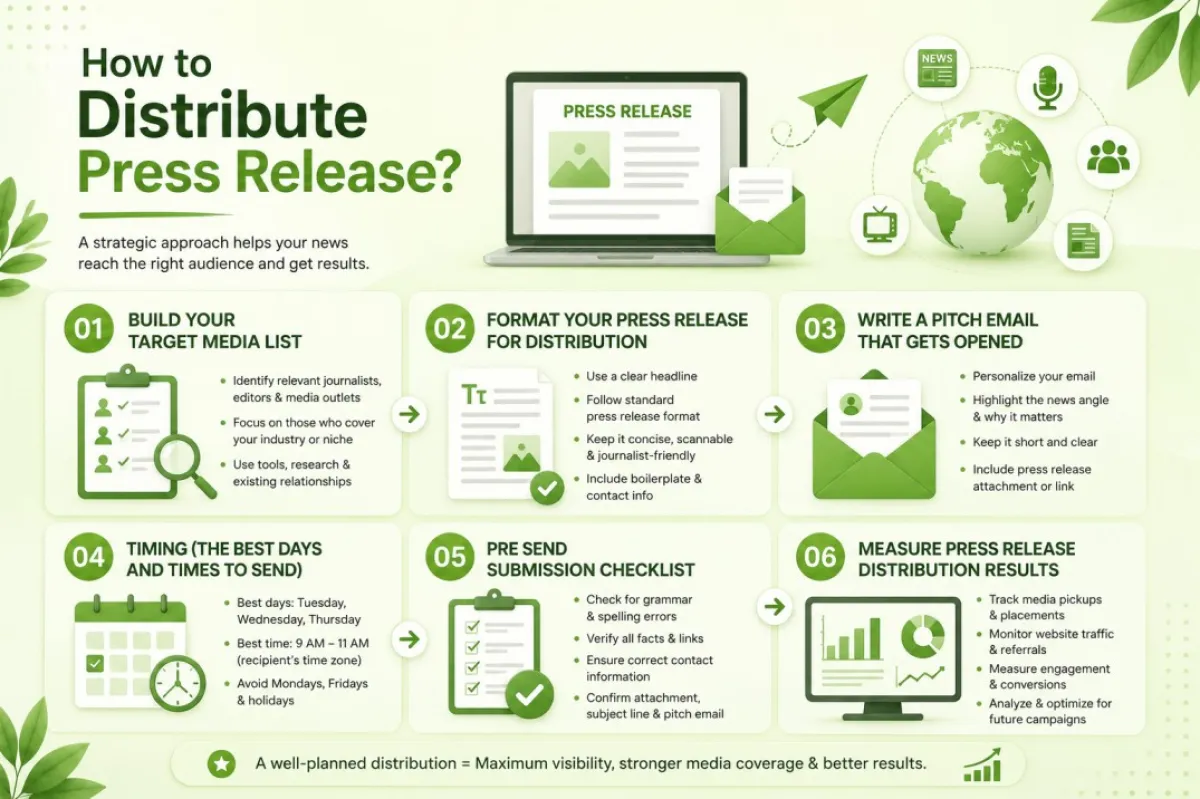
Press release distribution is the deliberate act of getting your news in front of the journalists, editors, and outlets most likely to cover it. It is not blasting a PDF to every email address you can find. It is a targeted strategy built around who should care about your news and how to reach them.
Companies distribute press releases for two core reasons: to earn editorial media coverage and to build SEO authority through backlinks and syndicated placements. Both are valuable. Both require different approaches.
Distribution makes sense when your news is genuinely newsworthy, a product launch, funding round, strategic partnership, executive hire, original research, or a company milestone that a journalist's readers would care about. If the news only matters internally, it is not ready to distribute yet.
The method you choose shapes the outcome. Get this decision right first.
Expert's Tip: "Distribution is where most press releases fail, not because the news wasn't good enough, but because it landed in the wrong inbox at the wrong time. Twenty perfectly targeted journalists will always outperform a blast to three hundred who don't care."
— EasyPRwire Team
DIY vs. Wire Service: Which Method Is Right for You?
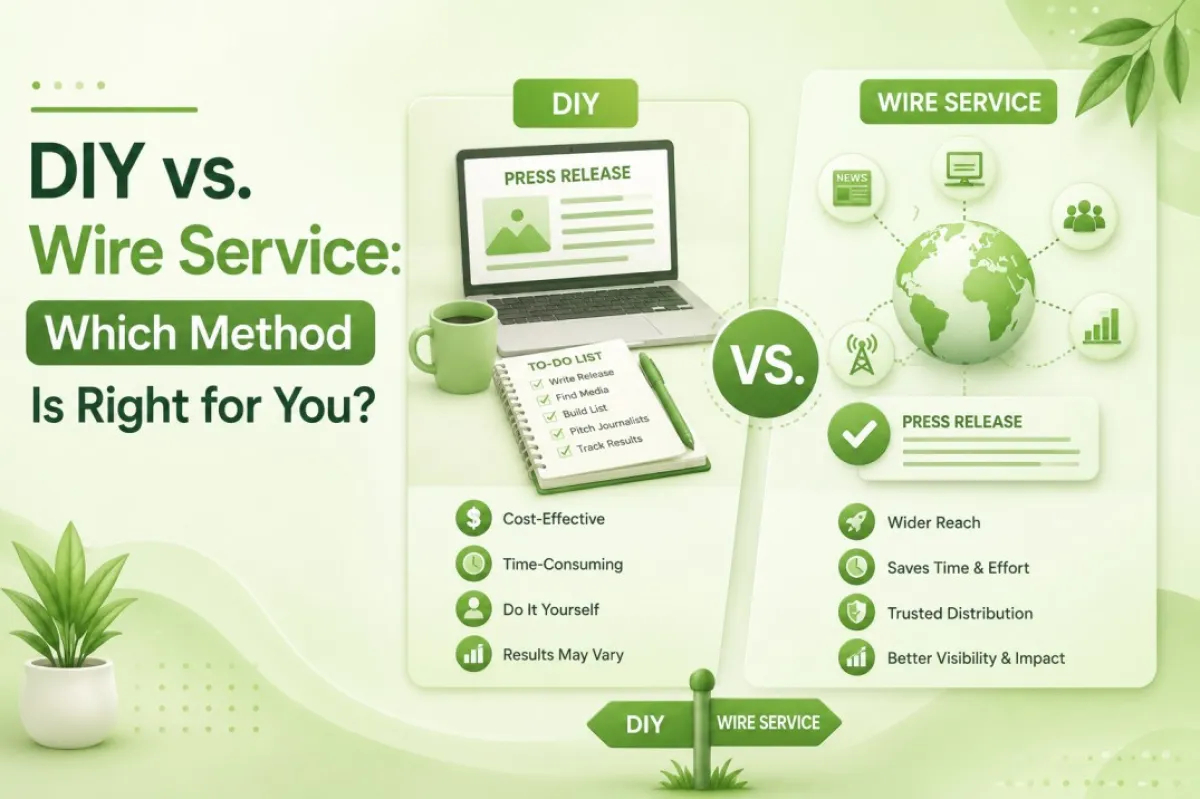
Direct (DIY) Outreach
Direct outreach means pitching journalists individually by email or social media using a media list you have built yourself. This is how editorial coverage actually happens. When a reporter writes a story about your company, it almost never came through a wire, it came from a targeted, personalized pitch.
Best for: Editorial coverage, niche industries, building reporter relationships, limited budgets.
Trade off: Time intensive. Requires a well researched media list and personalized outreach. No guaranteed placement, but the highest pickup rate per contact when done correctly.
Wire / Distribution Service
Wire or press release distribution services like EasyPRwire, PR Newswire, Business Wire, and GlobeNewswire push your release to their syndication network through curated outreach or automated feeds. You are buying exceptional reach and brand authority, with many placements offering guaranteed syndication across high value news networks.
Whether you are launching a global campaign or managing a targeted press release in australia, utilizing an established wire service gives your story immediate regional authority and broad indexing.
Best for: SEO backlinks, investor relations, public record, wide geographic syndication.
Trade off: Costs $150–$500+ per release. Volume of placements looks impressive but rarely drives direct leads or genuine editorial coverage on its own.
When to Use Both
For high stakes announcements, a funding round, major product launch, acquisition, use a wire service for SEO breadth and a public record, while simultaneously pitching a short list of targeted journalists directly for the story you actually want told.
Match the method to the goal. Wire for reach and SEO. Direct pitch for editorial coverage. Both for announcements that need to do heavy lifting on multiple fronts.
How to Distribute a Press Release: A Step by Step Guide for Maximum Media Coverage
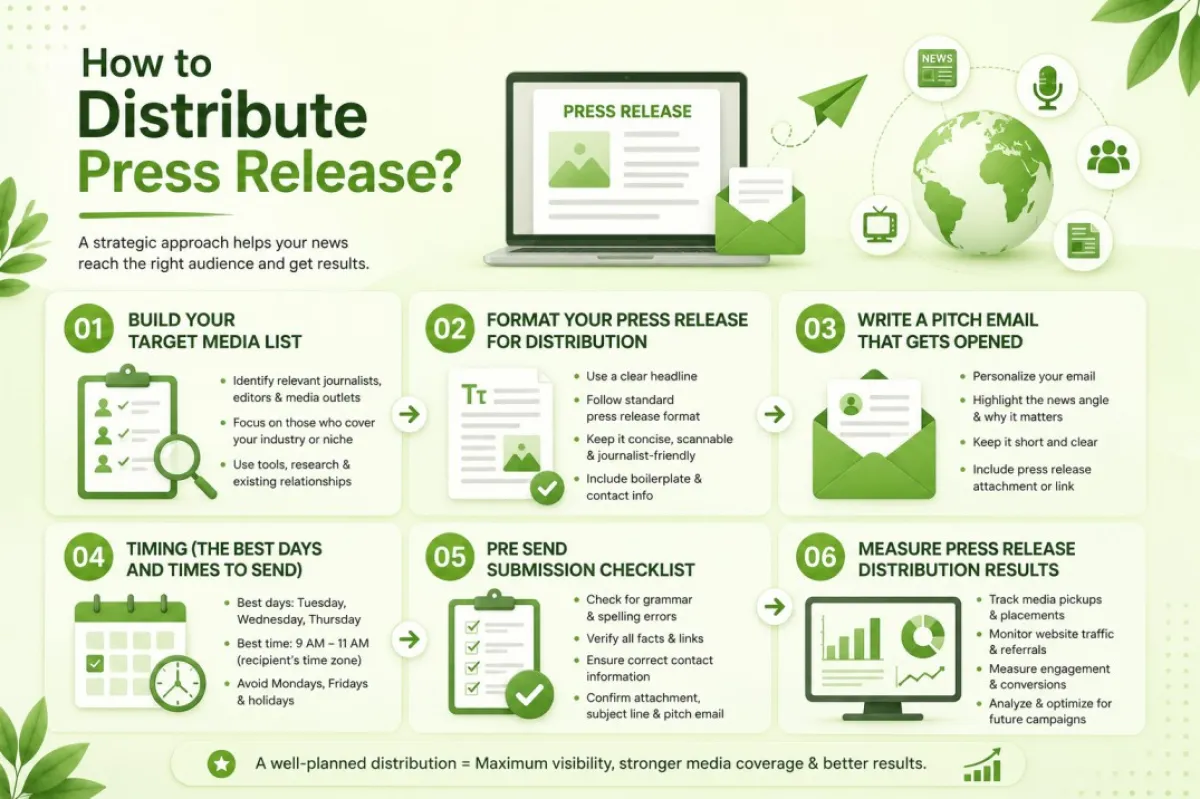
Step 1: Build Your Target Media List
A targeted media list is the difference between a press release that gets covered and one that gets ignored. Twenty well researched contacts will consistently outperform a blast to three hundred irrelevant ones.
How to find the right journalists:
Search Google for your topic + "reporter" or "journalist" + publication name
Check bylines on competitor coverage, who wrote about them?
Use LinkedIn and Twitter/X to find beat reporters active in your industry
Use media databases like Muck Rack, Cision, or Prowly for verified contacts at scale
How to organize your list:
By beat: Group contacts by what they cover: technology, finance, consumer, local business
By tier: Tier 1 (major nationals), Tier 2 (industry trades), Tier 3 (niche blogs and newsletters)
By relationship: Separate warm contacts from cold ones; each needs a different pitch approach
Before adding anyone to your list, read their three most recent articles. If none are relevant to your news, remove them. Sending to irrelevant journalists damages your sender reputation and burns future outreach.
One rule: Never send a generic blast. Personalize the first two lines of every pitch to each journalist's specific beat and recent work.
73% of journalists reject pitches because they're not relevant to their beat."
— Muck Rack, State of Journalism 2024
Step 2: Format Your Press Release for Distribution
Journalists scan releases in seconds. If the structure looks unfamiliar or the news is buried, they move on. Follow the standard format, every element has a reason.
Headline: Keep your press release headline under 65 characters. Lead with the news angle, not your company name. Specific beats are clever every time.
Dateline: City, Country, and Date. Open your first paragraph.
Lead paragraph: 2–3 sentences answering Who, What, When, Where, and Why. If a journalist reads nothing else, this paragraph must tell the whole story.
Body (2–3 paragraphs): Supporting details, context, market relevance, and data. Each paragraph adds new information, never restates what came before.
Quote: One attributed quote from a senior executive. It should add perspective, not repeat facts already in the release.
Boilerplate: 3–5 sentence "About [Company]" description. Keep it evergreen.
Media contact block: Name, email, and phone number at the bottom.
End marker: Three hash symbols (###) centered on their own line.
Key formatting rules: Keep the body to 400–600 words. Write in third person. Use AP Style. Don’t use exclamation marks, superlatives, and marketing language. For multimedia like images or videos, link to a shared folder, never attach files to your email.
87% of journalists use multimedia assets, images, data visualizations, and videos, when they're supplied with pitches and stories."
— Cision, 2024 State of the Media Report
Step 3: Write a Pitch Email That Gets Opened
The press release is what you send. The pitch email is what gets it opened. Most journalists decide in three seconds whether to keep reading, your subject line and opening sentence do all the work.
Subject line rules:
Keep it under 50 characters
Lead with the news angle, not your company name
Never write "PRESS RELEASE:" or "FOR IMMEDIATE RELEASE" in the subject line
Pitch email structure (keep it to 5 lines):
Why this story is relevant to their specific readers
The core news in one sentence
One compelling stat or detail that makes it credible
A link to the full press release, never an attachment
A brief offer to provide quotes, data, or an interview
Reference a recent article the journalist wrote. One specific sentence showing you read their work is worth more than three paragraphs of company background. Journalists remember who wastes their time and who respects it.
Step 4: Timing (The Best Days and Times to Send)
Timing is not a minor detail. Journalists triage their inboxes early, your release needs to land when they are actively reading, not buried under a Monday morning pile up or a Friday afternoon that nobody checks.
Send on: Tuesday, Wednesday, or Thursday Send between: 9:00–11:00 AM in the recipient's local time zone
Avoid: Monday mornings, Friday afternoons, public holidays, and major news days when your announcement will compete with breaking coverage
For planned announcements, send 24–48 hours before your desired go live date to give journalists enough lead time to prepare a story. If sending under embargo, state the embargo date and time clearly at the very top of the release.
For trade publications with weekly print or digital cycles, utilizing a full cycle PR distribution strategy is essential. So, research which day the publication goes live and send your release two to three days before.
Step 5: Pre Send Submission Checklist
Run through this before you hit send submit press release on anything.
Headline is under 65 characters and leads with the news angle
Lead paragraph answers Who, What, When, Where, and Why
All facts, names, titles, and figures are verified and spelled correctly
One attributed executive quote is included
Media contact information is current, name, email, and phone
Boilerplate "About" section is at the bottom
Release body is 400–600 words with no promotional language
Multimedia assets are available via a linked folder, not an attachment
Distribution method is confirmed, direct pitch, wire service, or both
Send time is scheduled for Tuesday–Thursday, 9–11 AM recipient time
How to Measure Press Release Distribution Results?
Sending the release is not the end of the process. Knowing whether it worked, and why, is what improves every future distribution.
Days 1–3 (Immediate signals):
Email open rate and click through rate if using a PR platform
Number of wire syndications and republications
Social shares and brand mentions
Weeks 1–4 (Media coverage):
Earned media placements tracked via Google Alerts, Mention, or Muck Rack
Domain authority of outlets that covered the story
Referral traffic from coverage in Google Analytics under Source/Medium
Weeks 2–8 (SEO impact):
New backlinks generated, tracked in Ahrefs or Semrush
Keyword ranking movement for target terms
Indexed syndications from wire distribution
What actually matters beyond the numbers: Leads, demo requests, investor inquiries, and partnership conversations directly attributed to the announcement. A hundred syndicated pickups on low authority sites means less than one story in a publication your buyers actually read. Track conversions downstream, not just placements.
Common Press Release Distribution Mistakes to Avoid
Distributing a press release can significantly boost your brand's visibility, but common distribution blunders often cause journalists to ignore pitches entirely. Maximizing your media outreach requires strategic formatting, precise timing, and highly targeted pitching. Avoiding these common mistakes in press release ensures your news reaches the right desks and secures the media coverage your business deserves.
Targeting Irrelevant Beats: Sending your announcement to journalists whose coverage areas have no connection to your news wastes time and guarantees your email gets deleted.
Attaching PDFs to Emails: Attaching the press release as a PDF instead of pasting the text or linking to it clutters inboxes and raises red flags for security filters.
Using Generic Subject Lines: Including phrases like "FOR IMMEDIATE RELEASE" or "PRESS RELEASE" in your email subject line kills open rates because it looks like spam.
Writing Promotional Copy: Crafting your release with biased, sales heavy language instead of neutral, objective news tone destroys your credibility with editors.
Mismanaging Media Follow Ups: Following up more than once can annoy busy reporters, while failing to follow up at all means missing out on potential coverage.
Pitching Non Newsworthy Topics: Distributing a story that lacks genuine public interest or a timely angle will fail to catch any journalist's attention.
Ignoring Recipient Time Zones: Failing to account for local time zones when scheduling your send results in your pitch burying itself at the bottom of an inbox.
Distribute Your Press Release With EasyPRwire (Starting at Just $89)
Get your news in front of high tier media outlets, journalists, and thousands of readers without breaking the bank. EasyPRwire makes professional press release distribution fast, affordable, and results driven with no hidden fees and no complexity.
Frequently Asked Questions
What does press release distribution mean?
Press release distribution means sending your news announcement to journalists, editors, and media outlets so it gets published and seen by your target audience. It is the step that turns a written release into actual media coverage, backlinks, and brand visibility.
How to distribute a press release?
To distribute a press release, follow these steps:
Write a newsworthy release: structured with a headline, dateline, lead paragraph, body, quote, boilerplate, and media contact
Build a targeted media list: identify 20–40 journalists who cover your industry or beat
Choose your distribution method: direct email outreach for editorial coverage, a wire service for SEO and syndication, or both
Write a short pitch email: five lines maximum, personalized to each journalist, with a link to the full release
Send at the right time: Tuesday to Thursday, between 9–11 AM in the recipient's time zone
Track your results: monitor pickups, backlinks, referral traffic, and media mentions after sending
What is the best way to distribute a press release?
The most effective press release distribution strategy combines direct outreach with a wire service:
Build a targeted list of 20–40 journalists who cover your industry
Send a short, personalized pitch email with a link to the full release
Submit to a wire service for SEO backlinks and wide syndication
Send on Tuesday, Wednesday, or Thursday between 9–11 AM
Follow up once after two to three business days
Which is the best press release distribution agency?
For businesses that need professional distribution without enterprise-level pricing, EasyPRwire is a strong choice, plans start at just $89, making it accessible for startups, small businesses, and growing brands. It covers wide distribution, SEO value, and straightforward pricing in one package. For large corporations or investor facing announcements, PR Newswire and Business Wire remain the industry standard, though pricing starts at several hundred dollars per release.
How does press release distribution work?
Press release distribution works through two channels:
Direct outreach: you send a personalized pitch email to targeted journalists who cover your industry. They review it and decide whether to cover the story.
Wire service: you submit the release to a distribution platform like EasyPRwire, which automatically syndicates it across its network of news sites and databases within hours.
In both cases, the release gets delivered, journalists or platforms decide whether to publish it, and coverage goes live generating backlinks, referral traffic, and brand mentions. The quality of your targeting and news angle determines the outcome.
How to distribute a press release for free?
You can distribute a press release for free through these methods:
Direct email outreach: pitch journalists on your own targeted media list
Free wire platforms: submit to PRLog, OpenPR, or PR.com for basic syndication
Your website newsroom: publish it on a /news or /press page for SEO indexing
Google Business Profile: post a summary as a business update for local visibility
LinkedIn and social media: share the announcement organically across company channels
What are the 7 parts of a press release?
A properly formatted press release contains these seven elements:
Headline: Under 65 characters, news forward, no company name first
Dateline: City and date at the start of the lead paragraph
Lead paragraph: Answers Who, What, When, Where, and Why in 2–3 sentences
Body paragraphs: 2–3 paragraphs of supporting detail, context, and data
Quote: One attributed statement from a company executive
Boilerplate: Standard "About [Company]" description, 3–5 sentences
Media contact: Name, email, and phone number, followed by ###


