
Press releases used to be simple: write a statement, send it out, and hope a journalist picked it up. But today, the media world moves much faster and so does the competition for attention.
A modern press release is a full communication engine, built to spark visibility, trust, search discovery, and global media reach. And the secret most brands still don't know?
A press release is not a one-step task. It is a full-cycle process.
In this guide, we break down each press release cycle stage, provide best practices, and explore why this approach is crucial for modern corporate PR.
Key Highlights:
- Full-cycle PR ensures your press release goes beyond a simple announcement, covering the entire process from draft to global media coverage.
- Each press release follows six core stages: crafting a story, SEO optimization, distribution, guaranteed placements, amplification, and performance tracking.
- Optimizing for search engines and integrating multimedia increases visibility and engagement across digital platforms.
- Targeted distribution and verified media placements help build credibility, trust, and measurable reach.
- Amplifying your release through social media, owned channels, and influencer outreach extends its lifespan and audience impact.
- Tracking metrics such as placements, impressions, backlinks, and domain authority allows continuous improvement and ROI measurement.
What Is Full-Cycle PR Distribution?
Full-cycle PR distribution is the whole cycle of writing, emailing and broadcasting a press release.
It encompasses all stages - from writing and refining your message to monitoring performance after going live.
Consider it a 360° PR solution wherein each stage is focused on maximizing visibility, credibility, and engagement.
What follows is what a full-cycle PR process involves:
- Crafting an engaging story
- SEO and media optimization
- Distributing through trusted media outlets
- Guaranteed placements
- Bolstering reach through online channels
- Tracking and analytics to measure coverage
Each one supports the others when done well by generating your brand more lasting attention than a solitary news release.
Why Full Cycle PR Matters in 2026?
The media landscape today is fast-moving, SEO-driven, and heavily digital. Readers and journalists consume news online first. Therefore, a simple press release sent via email or wire service is not enough. A full-cycle PR release:
- Ensures global media coverage.
- Aligns with search engines and news platforms.
- Provides data-driven insights for ongoing campaigns.
- Maintains consistent messaging across channels.
Old PR Wires vs. Full-Cycle PR
Traditional PR wires focused only on sending press releases. The success depended on chance coverage by journalists.
When mapping out these legacy workflows, teams frequently evaluate the mechanics of free vs. paid press release distribution platforms to see if a zero-cost option can support basic syndication or if paid architecture is required to guarantee visibility.
Modern full-cycle systems completely replace these static frameworks by integrating content creation:
- Content creation
- SEO optimization
- Targeted media distribution
- Guaranteed placements
- Amplification through owned and social channels
- Performance tracking and analytics
This end-to-end approach ensures that PR efforts generate measurable results rather than temporary exposure.
The Core Stages of a Full-Cycle PR Release
A full-cycle PR release consists of six integrated stages. Each stage supports the next, creating a 360° PR strategy that maximizes impact.
Stage 1: Writing the Best Press Release Draft
Every good PR begins with one thing: having something to say.
1. Define Your Core Message
Ask yourself:
- What is the genuine news hook here?
- Why will readers or journalists care?
- How does this affect your industry, customers, or investors?
Whether it's a funding announcement, product release, or company milestone, relevance and clarity are what will make a difference.
2. Use the Standard Press Release Format
A good press release should include:
- Headline: Concise, newsworthy, and keyword-rich
- Subhead: Offers context or second hook
- Lead Paragraph: Offers who, what, when, where, and why
- Body Paragraphs: Offer supporting details, facts, or quotes
- Boilerplate: Brief about your company
- Media Contact Information: For media reps or editors
3. Keep It Journalistic
Write like a reporter, not an ad. Refrain from promotion-sounding language and simple sentence structure. Editors prefer clear over clever.
Pro Tip: EasyPR's editorial staff critiques and refines each release to make it newsroom-quality and boost pickup rates.
Stage 2: Maximizing Digital Visibility
Writing the press release is half the fight; search and digital distribution optimization is how you get discovered.
1. SEO Optimization
Insert target keywords naturally into your:
- Headline and subhead
- First 100 words
- Anchor links (if permitted)
- Boilerplate
Such as with the use of keywords "digital PR distribution" or "corporate PR clients" to alert Google News to the subject matter and enhance findability.
2. Readability & Formatting
Reporters are speed readers. Use:
- Short paragraphs (2-3 lines)
- Bullets or number lists
- One quote per 300 words
- Consistent title and company name formatting
3. Multimedia Integration
Press releases that accompany graphics, like logos, product images or infographics gets read 70% more often.
EasyPR includes multimedia integration on all plans, so your release appears professional on any page.
Stage 3: Distribution Through Trusted Media Channels
Now that your story is fine-tuned, distribution comes next, the force behind visibility.
Outdated PR wires tack on extra fees by region or add-on, leaving marketers to guess.
That's why full-cycle press release distribution system makes it easy with clear pricing and guaranteed coverage.
Here's how press release distribution agency gets your release out:
- Syndication to Google News, Yahoo, MSN, and leading outlets
- Distribution to specialty media networks (finance, technology, lifestyle, etc.)
- Placement on high-authority online news sites
- Inclusion in search engine and media databases for journalist use
This ensures your release doesn't just get sent; it gets read.
Stage 4: Guaranteed Media Placements
Breadth without reach is meaningless.
Most PR wires merely "sent" your release but not in front of people.
That means:
- Your press release goes live on verified domains
- You receive proof links and screenshots
- You can post these placements on your website, social media, or investor newsletters
It is media-tested that you can utilize.
Stage 5: Extending Reach With Online Channels
Once you publish your press release, amplification ensures it does not end there.
1. Utilize SEO and Backlinks
Each publication link is a natural backlink that increases credibility for your site and ranks higher naturally.
2. Share Across Owned Media
- Publish on your company blog or newsroom
- Share on LinkedIn, X (Twitter), and industry forums
- Email newsletter send the press link
This drives more visibility and creates referral traffic from lots of places.
3. Influencer and Journalist Outreach
For business PR clients, targeted media outreach support helps identify relevant journalists and influencers to share or reference your release by extending its life past the first day of publication.
Stage 6: Tracking, Analytics, and Performance Reporting
The final step in full-cycle PR distribution is measurement because what gets measured, gets optimized.
Montior post-distribution analytics like:
- Number of placements
- Domain authority of published sites
- Total estimated reach and impressions
- Backlink information and social shares
These results help you:
- Measure ROI on PR investment
- Identify which types of announcements are most effective
- Tune future campaigns for more impact
Pro Tip: Measuring performance propels refining your PR approach over time by turning individual announcements into persistent brand expansion.
Why Full-Cycle PR Distribution Matters to Corporate PR Clients?
For business communications teams, reputation and visibility management need to be extremely accurate.
A disrupted PR process tends to be resource-inconsistent and result-poor.
Full cycle PR releases provide tangible business benefits:
Consistent messaging across all platforms
Scalable for recurring announcements (earnings, product launch pr)
End-to-end control over the PR process
Data-driven insights for smarter decisions
Reduces wasted PR budget
In short, full cycle PR is a strategic approach that guarantees every announcement generates measurable results.
How EasyPR Offers Full-Cycle PR Distribution?
EasyPR makes PR simple for any company size. From small startups to large enterprise firms with a full, start-to-end PR solution.
Follow these Full-Cycle PR Release to get Draft to Global Media Coverage: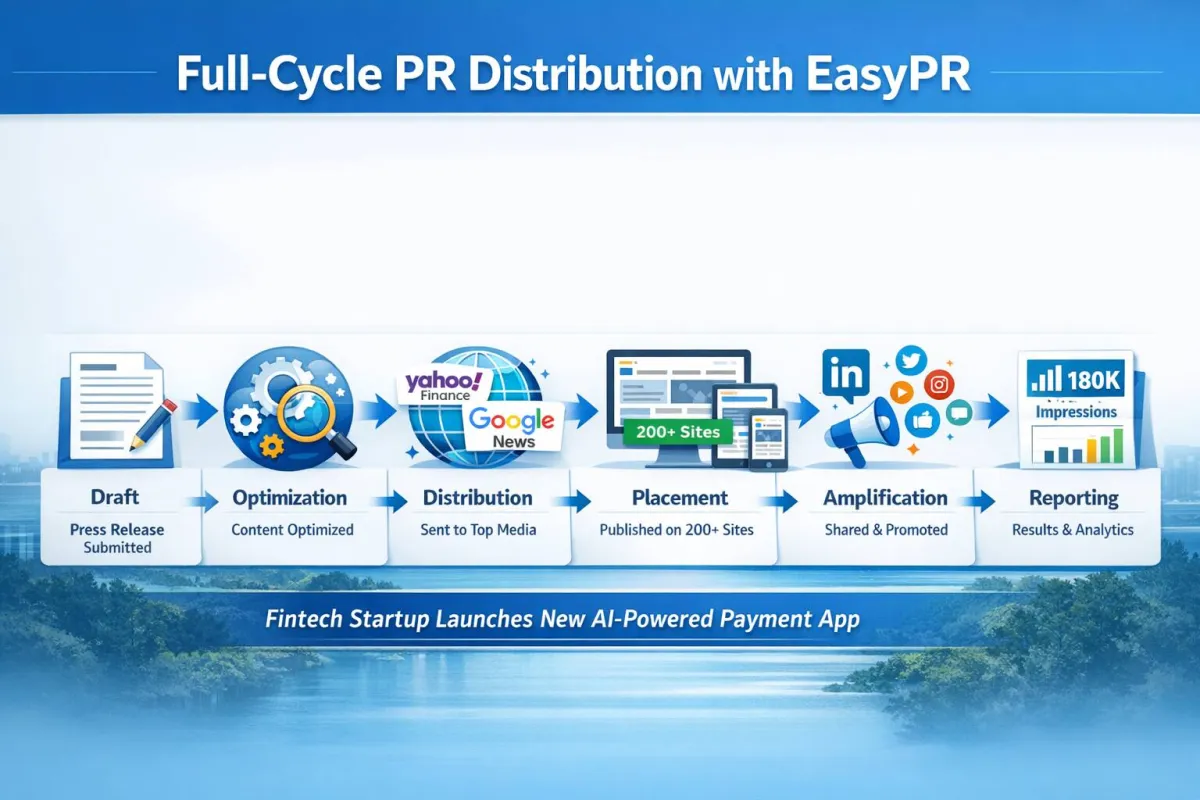 Flowchart for "Full-Cycle PR Distribution with EasyPR," detailing steps: Draft, Optimization, Distribution, Placement, Amplification, and Reporting.Suppose a fintech startup makes an announcement about its new payment app powered by AI.
This is how EasyPR's end-to-end press release distribution workflow plays out:
- Draft: The firm sends in its press release draft.
- Optimization: EasyPR editors optimize it for search engine ranking and readability.
- Distribution: The release is distributed to international sources such as Yahoo Finance and Google News.
- Placement: It is published on 200+ websites with backlinks.
- Amplification: The brand shares links on LinkedIn and gets organic media mentions.
- Reporting: EasyPR reports with 180K impressions and a few media pickups.
That is full-cycle PR, a whole process from conception to effect.
Conclusion
Press releases are no longer one-off documents. In 2026, brands require end-to-end PR cycles to maintain visibility, credibility, and audience engagement. From crafting an engaging story to tracking performance metrics, full-cycle PR ensures your announcements make a measurable impact.
By integrating SEO, multimedia, guaranteed placements, amplification, and analytics, companies can achieve global media coverage and consistent brand recognition.
The future of PR lies in data-driven, multi-channel, and fully integrated campaigns.
Go full-cycle, and your news will be seen, shared, and measured worldwide.
Frequently Asked Questions
What is a PR cycle?
A PR cycle refers to the stages a press release undergoes from creation to distribution, amplification, and measurement.
What is a full-cycle PR release?
It is a comprehensive process ensuring your announcement reaches media, is optimized for SEO, amplified online, and tracked for performance.
What are the 7 parts of a press release?
Headline, subhead, lead paragraph (5Ws), body paragraphs, quotes, boilerplate, media contact information.
What does PR coverage mean?
PR coverage measures how and where your press release was published, including reach, domain authority, and backlinks.
How do you write a media release statement?
Focus on a compelling news hook, follow the standard press release structure, write journalistically, and include multimedia where possible.


