
Most brands still treat PR as a one-time activity: write a press release, distribute it, and hope it gets noticed. Sometimes it works. Most of the time, the impact fades quickly.
What actually works today is connecting press releases with media coverage, your own website, and paid promotion so they support each other instead of working in isolation. When paid, owned, and earned media are aligned, PR stops being about short-term visibility and starts delivering long-term credibility and results.
In this guide, we explain how to integrate paid, owned, and earned media into one PR strategy, where press releases fit in this system, and how agencies and brands can use this approach to get consistent, measurable outcomes.
KEY HIGHLIGHTS:
- Paid, owned, and earned media work best when planned together as one PR strategy instead of being used separately.
- Press releases act as the main starting point by hosting the official message on your website or press room.
- Media coverage builds trust by showing that independent publications are talking about your brand.
- Paid promotion helps the right audience see your press coverage and key announcements at the right time.
- All PR activity should lead people back to clear, useful pages you control, such as press releases or landing pages.
- Consistent messaging across press releases, media coverage, and ads improves credibility and search visibility.
- A connected PR approach delivers longer-lasting results than one-time press releases or short ad campaigns.
What Are Paid, Owned, and Earned Media?
Before integration, each media type must be clearly defined. Paid, owned, and earned media serve different purposes in PR, and integration only works when those roles are understood.
This framework is a direct result of the evolution of press releases, moving from simple static announcements to dynamic digital assets that function across multiple channels.
Today, understanding these three categories is essential for navigating a modern media landscape.
Paid Media
Paid media refers to any exposure a brand pays for to distribute its message to a targeted audience.
Common examples include:
- Search engine ads
- Social media ads
- Sponsored articles
- Native advertising
- Content amplification campaigns
Role in PR: Paid media provides speed, reach, and control. It ensures that press releases, announcements, or media coverage reach the right audience at the right time.
Limitation: Paid media does not create trust on its own. It works best when it promotes credible content such as press coverage or authoritative owned assets.
Owned Media
Owned media includes all digital assets a brand fully controls and manages.
This typically includes:
- Website pages
- Blog content
- Online press release archives
- Landing pages
- Brand social media profiles
- Email newsletters
Role in PR: Owned media is the foundation of any PR strategy. It is where your official messages live and where audiences go to learn more after discovering your brand.
Why it matters for PR agencies: Every press release, media mention, and paid promotion should lead back to strong owned content. Without it, visibility does not turn into trust or conversions.
Earned Media
Earned media is exposure gained through third-party sources without direct payment.
Examples include:
- News coverage
- Journalist mentions
- Editorial features
- Industry publications
- Expert quotes and interviews
Role in PR: Earned media builds credibility and authority. It shows that independent sources consider your brand newsworthy or trustworthy.
Limitation: Earned media is difficult to scale on its own and depends heavily on strong owned content and strategic amplification.
Why Integrating Paid, Owned, and Earned Media Matters in PR?
Treating paid, owned, and earned media as separate activities reduces the overall impact of PR. Today, audiences experience brands across multiple channels at the same time, and PR strategies must reflect that reality.
1. Audiences Consume Media Holistically
People do not think in terms of “PR,” “ads,” or “content.” A typical journey often looks like this:
- They see a headline or media mention
- They search for the brand online
- They read a press release or article
- They visit the website
- They later encounter a retargeting ad
If the message changes or feels disconnected at any stage, trust weakens and interest drops.
2. Press Releases Alone Are Not Enough
Press releases are still essential, but their impact is limited when used on their own.
Publishing a press release without amplification reduces visibility
Media coverage without strong owned landing pages limits conversions
Distribution without retargeting leaves demand untapped
This is what using press releases strategically in PR really means when integrated properly, they become long-term assets that support visibility, credibility, and growth rather than one-time announcements.
3. PR Is Now Measured by Business Impact
Modern PR is no longer judged only by impressions or mentions. It contributes directly to:
- Brand search growth
- Lead quality and intent
- Investor and stakeholder trust
- Long-term brand reputation
An integrated PR strategy makes these outcomes measurable by connecting coverage, content, and promotion into one system.
How Paid, Owned, and Earned Media Work Together in a PR Strategy?
Paid, owned, and earned media do not operate in isolation in an effective PR strategy. Each channel supports the others by performing a specific role within one connected system, ensuring visibility, trust, and conversion work together rather than separately.
Media Roles Across the Funnel:
Earned media builds awareness and trust at the top of the funnel by introducing your brand through independent, credible sources such as news outlets and industry publications.
Owned media supports the middle of the funnel by providing detailed information, official messaging, and clear next steps through press releases, website pages, and other brand-controlled assets.
Paid media accelerates reach and performance at the bottom of the funnel by amplifying key messages, promoting earned coverage, and retargeting audiences who have already shown interest.
Press releases often sit at the intersection of all three. They act as owned content, support earned media coverage, and provide strong material for paid promotion when visibility needs to scale.
Building a framework around a unified press release strategy for marketing and social media makes it easier to balance these moving pieces across every channel simultaneously.
For SaaS companies as well as other growth-focused brands, this cross-funnel role becomes more effective when press releases are intentionally structured to support awareness, consideration, and lead conversion at each stage.
The Integrated PR Flywheel Framework (Paid, Owned, and Earned Media)
The integrated PR flywheel explains how press releases, media coverage, and paid promotion work together to create ongoing visibility instead of one-time results.
Rather than stopping after publication, each step feeds into the next and strengthens the overall PR impact.
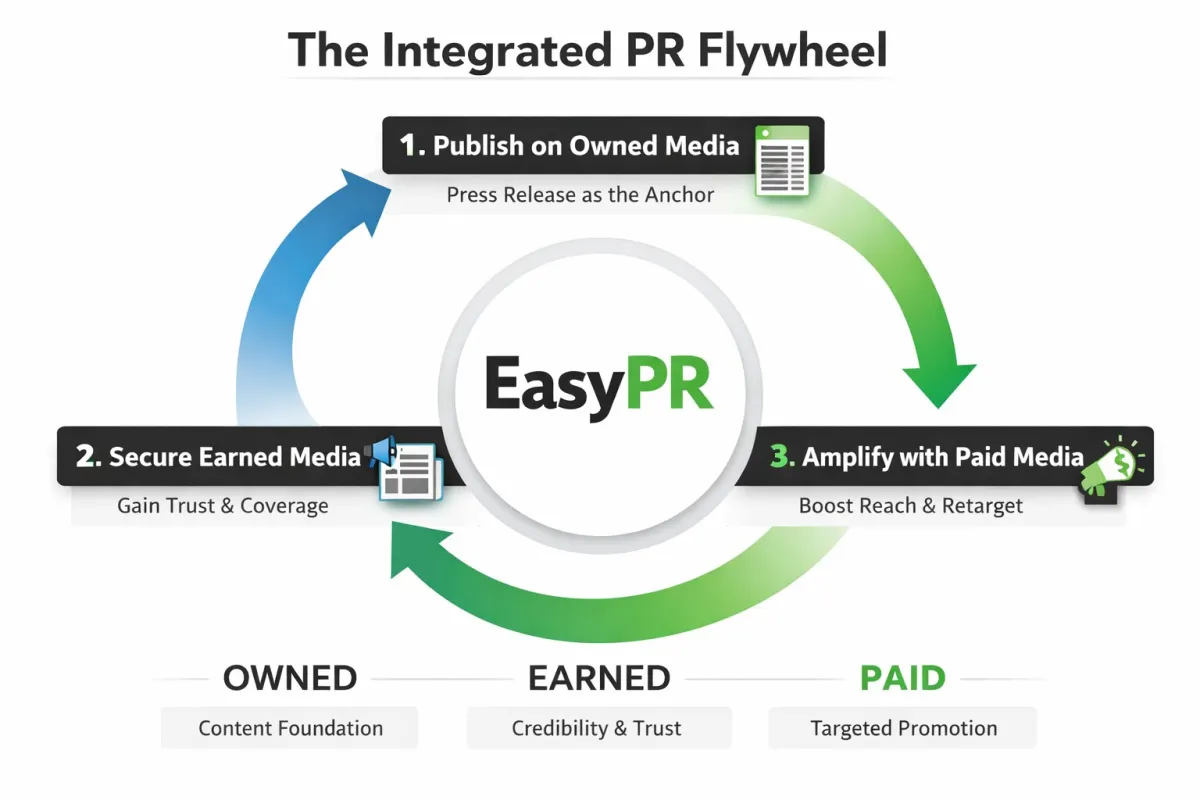 Diagram of the Integrated PR Flywheel with three steps around a central 'EasyPR' logo. Step 1: Publish on Owned Media, 2: Secure Earned Media, 3: Amplify with Paid Media. Arrows indicate a circular flow. Keywords: Owned, Earned, Paid media. Tone: Informative.
Step 1: Publish on Owned Media (Press Release as the Starting Point)
The process begins with a well-written, high-quality press release published on your own platform, such as your website or online press room.
At this stage:
- The press release acts as the official source of information
- It provides a permanent, indexable page for search engines and AI systems
- It links to relevant product pages, reports, or supporting resources
This step ensures your message has a clear home that you control.
Step 2: Secure Earned Media Coverage
Once the press release is live, it becomes the foundation for media outreach.
In this step:
- Journalists are pitched using the press release for context and accuracy
- Key data points, announcements, or insights are highlighted
- Coverage is earned from relevant publications that reference or link back to the release
Earned media adds third-party validation, which significantly increases credibility and trust.
Step 3: Amplify with Paid Media
After coverage is secured, paid media is used to extend reach and sustain momentum.
This includes:
- Promoting earned articles or media mentions through paid social or native ads
- Retargeting users who read the press release or related coverage
- Keeping the announcement visible beyond the initial news cycle
Paid media turns credibility into scalable visibility rather than short lived attention, especially when supported by enterprise level PR distribution tools and outreach platforms.
Why This Framework Works
Each media type supports a specific role within the system:
- Owned media provides structure, control, and depth
- Earned media delivers trust and independent validation
- Paid media expands reach and reinforces key messages
Because each step feeds the next, PR efforts continue generating value instead of ending after publication.
The Role of Press Releases in an Integrated PR Strategy
Press releases are no longer standalone announcements. In an integrated PR strategy, they act as multi-purpose assets that support search visibility, media coverage, and paid promotion at the same time.
When properly structured and distributed, a single press release can drive long-term value across all three media types instead of delivering short-lived exposure.
1. Press Releases as SEO Assets
Press releases published on owned platforms play a direct role in search visibility.
Well optimized press releases continue delivering traffic and authority long after publication.
They:
- Create indexed pages that rank for brand, product, and announcement-related searches
- Serve as reliable source content for AI Overviews and answer engines
- Act as internal linking hubs that connect announcements to core pages
For ecommerce and product-driven brands, this SEO impact increases when press releases are intentionally optimized for search intent, structure, and long-term discoverability.
2. Press Releases as Earned Media Triggers
Press releases also support earned media by providing journalists with clear, accurate information. A strong press release makes it easier for media outlets to cover the story accurately.
They:
- Help journalists verify facts and context quickly
- Increase pickup potential when structured clearly
- Improve editorial alignment through consistent messaging
3. Press Releases as Paid Media Assets
Press releases and earned coverage strengthen paid promotion. This is where press release agencies gain the most leverage from integration. Utilizing continuous press release distribution in branding marketing allows teams to turn basic paid outreach into an authoritative narrative.
They:
- Make ads more credible when promoting third-party media coverage
- Improve click-through rates by using trusted headlines and sources
- Support retargeting by reinforcing authority and recognition
How to Measure Success in an Integrated PR Strategy?
PR success is no longer measured by impressions or mentions alone. Integrated PR focuses on outcomes that reflect real business impact.
1. Cross-Channel Measurement
Effective measurement looks at how channels influence each other.
Track:
- Increases in branded search after media coverage
- Conversion rates from press release and coverage traffic
- Retargeting performance following earned exposure
2. Business-Focused KPIs
Modern PR reporting replaces vanity metrics with indicators that matter.
Focus on:
- Qualified leads
- Conversion attribution
- Customer lifetime value
- Long-term reputation impact
Common Mistakes to Avoid in Integrated PR
Even strong PR efforts lose value when integration is missing.
Avoiding these mistakes is what separates modern PR from outdated tactics.
- Publishing press releases without clear owned landing pages
- Chasing media coverage without amplification
- Running paid ads without credibility signals
- Measuring PR separately from business performance
Final Takeaway
The most effective PR strategies do not choose between paid, owned, or earned media. They integrate all three into one connected system.
For press release agencies and PR teams:
- Owned media provides structure
- Earned media delivers credibility
- Paid media provides scale
When aligned, press releases become more than news. They become long-term reputation and growth assets.
Frequently Asked Questions
How do paid, owned, and earned media work together in PR?
Paid, owned, and earned media work together by sharing one message across different channels, where owned media hosts the content, earned media builds trust through third-party coverage, and paid media expands reach and visibility.
Are press releases still effective in modern PR strategies?
Yes, press releases are still effective when used as owned media assets that support media coverage, search visibility, and paid promotion rather than one-time announcements.
What is the role of press release distribution in an integrated PR strategy?
Press release distribution helps place the message in front of journalists and audiences, while integration ensures that coverage, website content, and paid promotion work together for longer-term impact.
What is the biggest mistake brands make when using press releases?
The biggest mistake is treating press releases as one-time announcements instead of long-term assets. Without linking them to owned landing pages, media coverage, and follow-up promotion, most press releases fail to deliver lasting visibility or business impact.
How long does an integrated PR strategy take to show results?
An integrated PR strategy can show early visibility within days through distribution and paid amplification, while trust, search visibility, and measurable business outcomes typically build over weeks or months as earned coverage and owned content compound.

