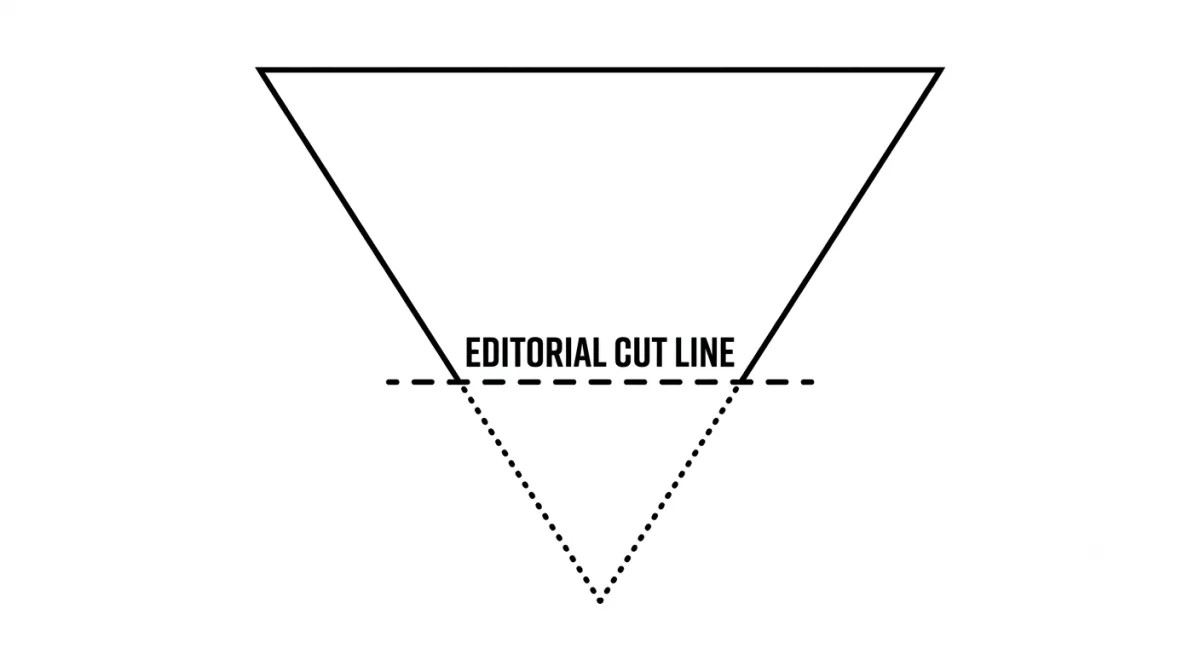
The inverted pyramid writing style is a news story structure that places the most vital information at the top, narrows through supporting detail, and ends with background a reader could skip without losing the point.
It is the reliable inverted pyramid structure behind nearly every hard news story, wire report, and press release published today. Journalists rely on it because it survives edits, cuts, and short attention spans without losing meaning.
What Is the Inverted Pyramid Writing Style? (Definition and Structure)
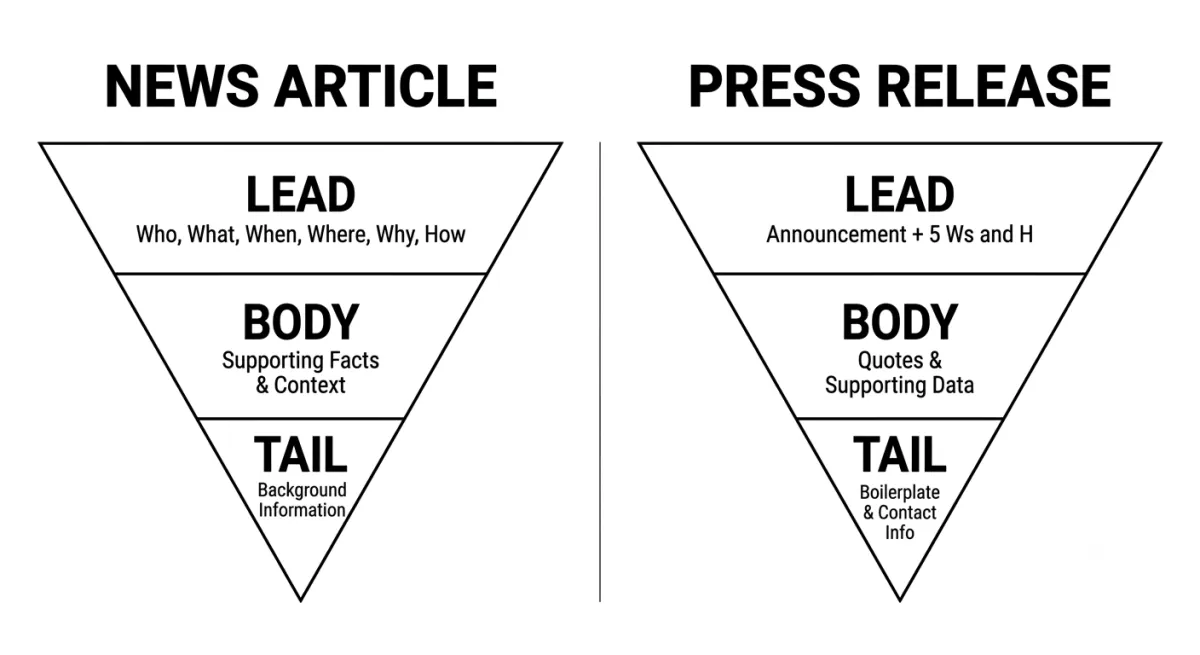
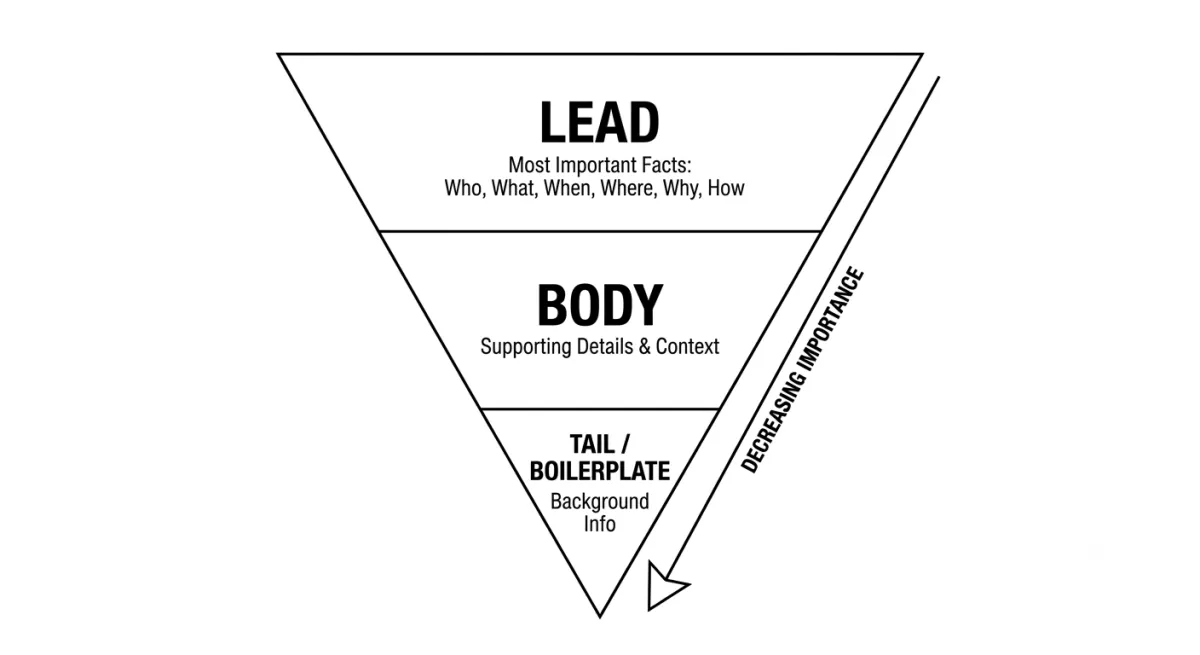
The inverted pyramid structure organizes content from most important to least important, built across three layers: the Lead, the Body, and the Tail. Picture a triangle standing on its point, widest at the top where the essential facts sit, narrowest at the bottom where background waits.
Tier | Position | Function |
Lead | Top (widest) | States the news: who, what, when, where, why, how |
Body | Middle | Adds supporting facts and context, ranked by relevance |
Tail / Boilerplate | Bottom (narrowest) | Holds background info or a standard closing |
This format has roots in wire journalism. Once telegraph technology let reporters send stories over long distances, transmission was slow and unreliable, so the most essential information had to go first in case the line dropped.
Newsrooms spent decades refining the method, and journalism style guides, including academic references published by Oxford University Press, still teach it as the backbone of hard news writing.
Some newsrooms also build a nut graf into the first few paragraphs, a single paragraph that states why the story matters beyond the raw facts in the lead. Any team that follows a solid press release drafting framework structures content around this same hierarchy before a draft ever reaches final review.
The Lead Paragraph: How the 5 Ws and H Anchor the Top of the Pyramid
The lead paragraph answers the reader's first question before they finish it: what happened, and why does it matter? It sits at the widest point of the pyramid and carries the most important information in the entire piece.
Every strong lead works through the five Ws and H:
Who is involved
What happened
When it happened
Where it happened
Why it matters
How it unfolded
A tight lead answers as many of these as it can within 25 to 35 words. Reporters test a draft lead by reading only the first sentence and asking whether a reader could still summarize the story from that alone.
"[Who] The city council [What] approved a $12 million transit expansion [When] on Tuesday [Where] in downtown Portland [Why] to reduce commuter congestion [How] by adding three new rapid-transit lines."
Teams that regularly produce polished digital press releases run this same six-part check at the beginning of every draft. If a lead fails to make sense on its own, in under one paragraph, it gets rewritten before anything else moves forward.
"Most press releases fail before the second paragraph, not because the news isn't good, but because the writer buried it. If a journalist can't find your headline fact in the first ten seconds, they move to the next email in their inbox."
— EasyPRWire Editorial Team
The Body: Supporting Details and Background Info in Descending Priority
The body of an inverted pyramid piece answers one question: what other information does the reader need, ranked by relevance rather than by the order events happened? This is where most drafts break down.
Supporting details reinforce the lead. Background info gives context a reader could skip without losing the story. Confusing the two is the most common mistake covered in serious press release writing best practices training.
Compare two versions of a body paragraph following the same lead about a product recall:
Wrong order: Opens with the company's founding year, mentions the recall was issued after three complaints, then finally states which product model is affected.
Correct order: States which model is affected, cites the complaint count that triggered the recall, then closes with the founding year as background.
Essential facts remain intact under this method even if a reader loses connection with the piece halfway through, closes the tab, or the outlet trims the rest for space. A capable in house release drafting team ranks body paragraphs by news value first and company preference last, every time.