

A whitelisted test environment lets financial institutions issue, pay and control treasury funds on post-quantum infrastructure before tokenized deposits and stablecoins scale
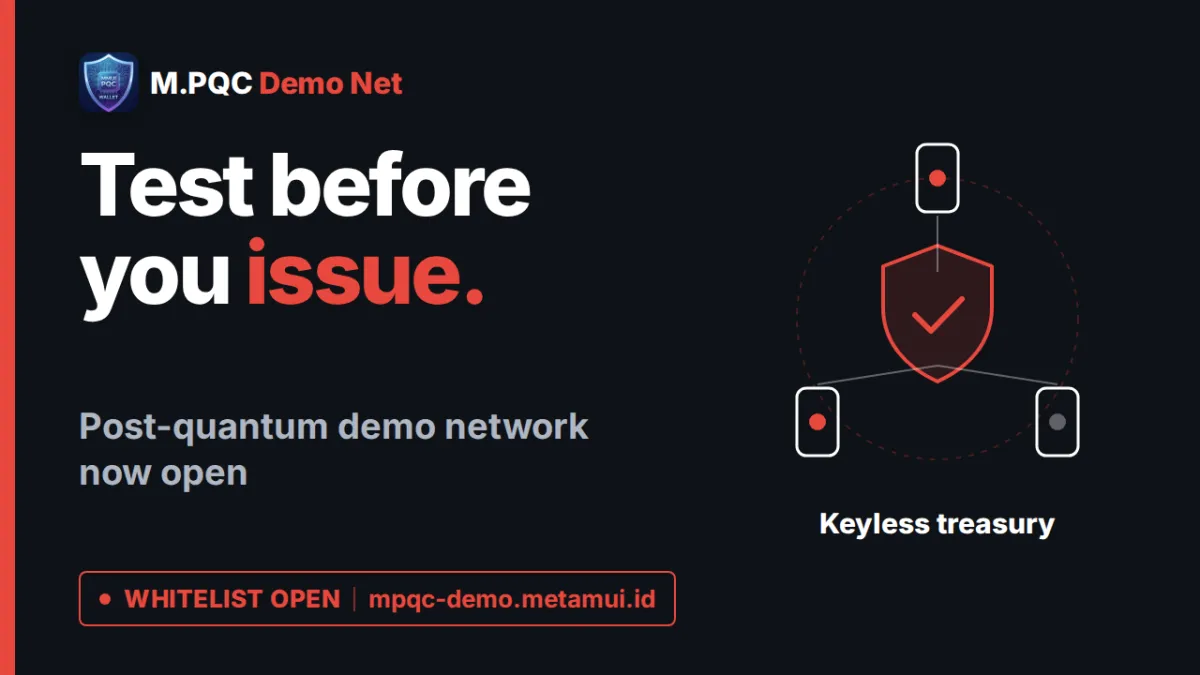
MetaMUI has opened a permissioned demonstration network to financial institutions, giving banks, payment firms and stablecoin issuers a place to test post-quantum token issuance, payments and treasury controls before committing capital to a platform.
The decision that can't be undone
A token inherits the cryptography of the network it is issued on, and the issuer cannot change it on its own schedule. Deposit tokens and regulated stablecoins are meant to circulate for years.
The calendar is set. A June 2026 U.S. executive order requires federal agencies' most sensitive systems to adopt post-quantum key establishment by December 31, 2030 and post-quantum digital signatures by December 31, 2031. Korea's national roadmap targets 2035. For institutions choosing an issuance venue now, the question is what migration will cost once assets are already on the ledger.
On most networks an address is derived from a key, so new cryptography means every holder moving their balance. MetaMUI's mainnet moved every existing user to post-quantum signatures on September 13 without any of them doing so, because an account on MetaMUI is a verified identity rather than a key.
Fewer moving parts
Most blockchain platforms arrive as developer kits. Institutions build token contracts, issuance logic and integrations, then source a wallet separately — each piece from a different vendor, each connection a new cost and a new exposure.
MetaMUI ships as a finished product: issuance from an administration console on a cloud-hosted network, with the M.PQC Wallet built in so holders can receive, send and pay from day one. A network is only post-quantum end to end if the signing wallet is too. Institutions that want their own wallet can use the published Wallet SDK.
Treasury risk without a key
Institutional funds sit in keyless protocol accounts with no private key. Transfers move only when a majority of designated operators sign. One operator signs a request naming the recipient and the amount; the others verify that signature against the chain's identity registry before adding their own post-quantum signatures. The protocol then executes exactly what was signed, and records each step on the chain.
No single administrator can move funds and no single stolen key is enough — the separation-of-duties principle from NIST's security controls, built into the account. Operators' keys are stored encrypted under keys that never leave each phone's hardware keystore.
Retail-facing wallets carry no seed phrase: a lost key is replaced on the same identity, and the balance stays put.
What institutions can test
Participants can issue deposit tokens and stablecoins without writing or auditing token contracts, send and pay end to end, approve treasury transfers by operator vote, measure settlement finality under their own load, rotate keys without moving balances, and approve cross-chain transfers. The network exists so institutions can produce their own figures for due diligence.
Also released
MetaMUI published a post-quantum cryptography library under Apache 2.0, covering the four NIST standards and Korea's four K-PQC algorithms in one codebase, usable without MetaMUI. Hardware-accelerated builds are sold commercially; formal proofs in the Lean theorem prover are to follow.
How to participate
Financial institutions can apply at https://mpqc-demo.metamui.id. Approved institutions receive access to run their own issuance, payment and treasury scenarios, then work directly with the MetaMUI team on additional features, integration with existing systems and fit for their requirements. The library is available at https://github.com/SovereignWallet-Network/metamui-crypto.
About MetaMUI
MetaMUI is an identity-native blockchain built for regulated financial infrastructure, developed by SovereignWallet. An account is a verified identifier and a key is a credential registered against it, allowing cryptography to be upgraded without users moving assets.
Following its September 2026 hard fork, MetaMUI operates on post-quantum cryptography across transaction signing, identity and consensus. The network has been identity-based since 2021 and is designed for regulated payments, stablecoin settlement, deposit tokens and central bank digital currency. SovereignWallet also publishes an open-source post-quantum cryptography library covering NIST and Korean standard algorithms.
Demo network whitelist: https://mpqc-demo.metamui.id
PQC library (Apache 2.0): https://github.com/SovereignWallet-Network/metamui-crypto
M.PQC Wallet (Android · iOS): download links at https://mpqc-demo.metamui.id
Blue Paper: https://sovereignwallet-network.github.io/Home-whitepaper/MetaMUI-Blue-Paper.pdf
Explorer: https://explorer.metamui.id
Website: https://sovereignwallet.network
X: https://x.com/MMUI_Official
Media Contact: contact@swnglobal.com


