
Every message a PR professional shares shapes how the public views an organization. Inaccurate information, unclear disclosures, or misleading statements can quickly damage credibility, invite legal trouble, and weaken public trust.
Public relations professionals must follow both legal limits and ethical standards to ensure accurate, transparent, and responsible communication.
This guide explains the legal and ethical guidelines for PR professionals, covering press releases, media outreach, disclosure practices, confidentiality, and privacy. It helps public relations practitioners avoid legal risks while maintaining professional integrity.
Key Highlights:
Legal and ethical guidelines help PR professionals avoid lawsuits that can damage an organization’s reputation.
Ethical standards promote honesty, fairness, and transparency across all public relations activities.
Press releases must be accurate and thoroughly fact-checked to prevent misleading claims.
Sponsored and paid content must be clearly disclosed to maintain transparency.
Privacy rules require safeguarding confidential and private information, including journalist contact data and media lists.
Ethical public relations practices help build long-term trust with journalists and the public.
What Are Legal and Ethical Guidelines in Public Relations?
Legal and ethical guidelines are the foundation of professional practice in public relations. Legal guidelines are enforced by governments and regulators, while ethical standards are set by professional organizations to guide responsible decision making.
Public relations professionals are responsible for balancing advocacy, accuracy, and accountability while representing organizations in the public sphere.
Following both helps public relations professionals protect their organizations, provide objective counsel, and aid informed public debate.
Legal Guidelines vs Ethical Standards
Aspect | Legal Guidelines | Ethical Standards |
Definition | Rules enforced by government or regulators | Principles set by professional bodies |
Consequence of violation | Fines, lawsuits, penalties | Loss of trust, credibility, reputation |
Examples | Defamation laws, privacy rules, advertising regulations | Codes of ethics, fair disclosure |
Purpose | Enforce compliance and prevent legal harm | Maintain public trust and professional integrity |
Legal guidelines are mandatory. Ethical standards guide ethical conduct when the law is unclear.
Legal guidelines define the legal limits within which PR professionals must operate. These rules exist to protect client organizations, the public, and the broader communication ecosystem.
Ethical standards exist to guide professional conduct across all areas of public relations practice. They help PR professionals apply ethical principles consistently, even when facing time pressure, competing interests, or unclear legal guidance.
Why PR Professionals Must Follow Legal and Ethical Standards?
PR professionals must follow legal and ethical standards to protect their client organization, the public, and their own professional credibility. Legal rules define minimum requirements, but ethical obligations guide responsible decision making when laws are unclear or incomplete.
By following ethical standards, PR professionals can provide objective counsel, manage personal and professional interests appropriately, avoid deceptive practices, and ensure ethical conduct across all communications. This balanced approach supports informed decision making, promotes respect for affected parties, and strengthens trust in the public relations profession.
By following both legal and ethical guidelines, PR professionals:
Communicate responsibly
Protect the public interest
Maintain credibility with journalists
Support healthy and fair competition
Strengthen the pr profession
Core Ethical and Legal Risks in Public Relations
Public Relations professionals balance advocacy with responsibility. Mistakes in this process can compromise good business judgment and damage trust.
Understanding these risks helps PR teams prevent ethical challenges and legal exposure.
1. Loss of Trust from Ethical Failures
Trust is the foundation of ethical public relations. Journalists and audiences expect accurate and truthful information. When PR professionals exaggerate claims, withhold relevant facts, or fail to disclose financial interests, trust erodes quickly.
Additionally, over saturating newsrooms with repetitive angles can burn bridges; understanding how frequently to pitch media is essential to respecting journalists' time and preserving editorial goodwill.
Common ethical failures include:
Not labeling sponsored or paid content
Providing selective or misleading statistics
Withholding material information from media
Ethical practices ensure transparency, promote respect, and protect long-term media relationships.
2. Legal Risk in PR Communications
Every press release distribution and media statement carries legal responsibility. Key risks include:
Defamation or libel through false statements
Misleading claims that violate advertising rules
Privacy violations involving confidential information
Failure to comply with legal requirements can lead to lawsuits, penalties, and reputational damage. Ethical public relations and proper ethical decision making reduce these risks.
Ethical Standards Every PR Professional Should Follow
Ethical standards guide responsible advocacy and professional conduct in public relations.
Ethical standards are defined by professional bodies such as the Public Relations Society of America, the International Association of Business Communicators (IABC), and the International Public Relations Association.
Violating these standards may not always result in legal penalties, but it can seriously compromise professional standards and credibility.
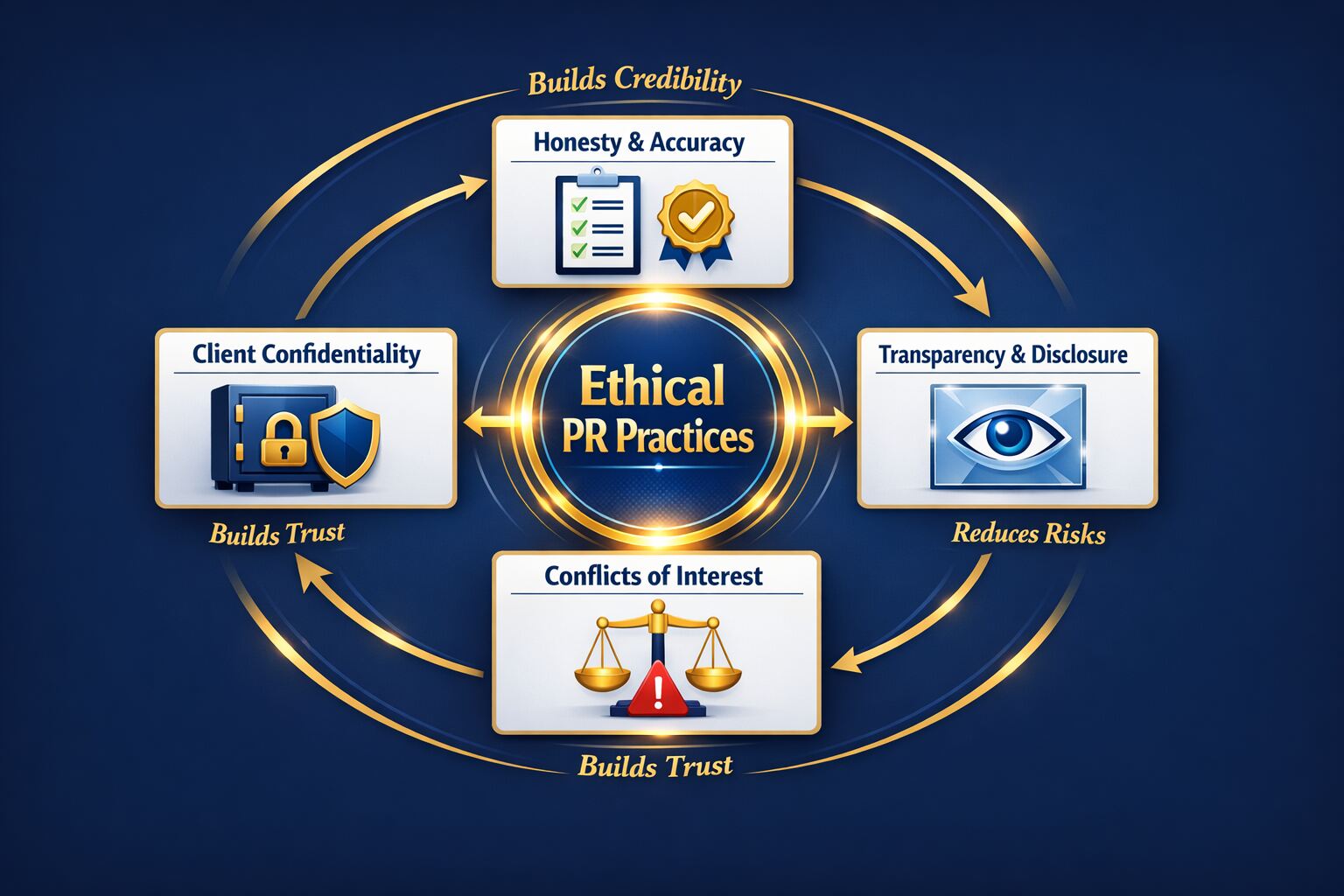
Honesty and Accuracy
All communications must be accurate, fact-checked, and supported by evidence. Errors must be corrected promptly. Accurate and truthful information is a core ethical principle.
Transparency and Disclosure
Sponsored content, paid media, and financial interests must be clearly disclosed. Audiences must understand when content is promotional. Ethical communication requires openness and clarity.
Conflicts of Interest
Existing or potential conflicts must be disclosed. Undisclosed interests can compromise credibility and violate ethical obligations.
Client Confidentiality
PR professionals must safeguard confidential and private information, including media lists and client data. Protecting confidential information is essential to professional practice.
Responsible Advocacy
PR professionals are responsible advocates for their clients while serving the public interest. Advocacy must never involve deceptive practices, malicious rumors, or undisclosed interest groups.
Legal Guidelines PR Professionals Cannot Ignore
Proper press release legal compliance is essential in public relations. Violating legal limits can result in serious consequences, including lawsuits and reputational damage.
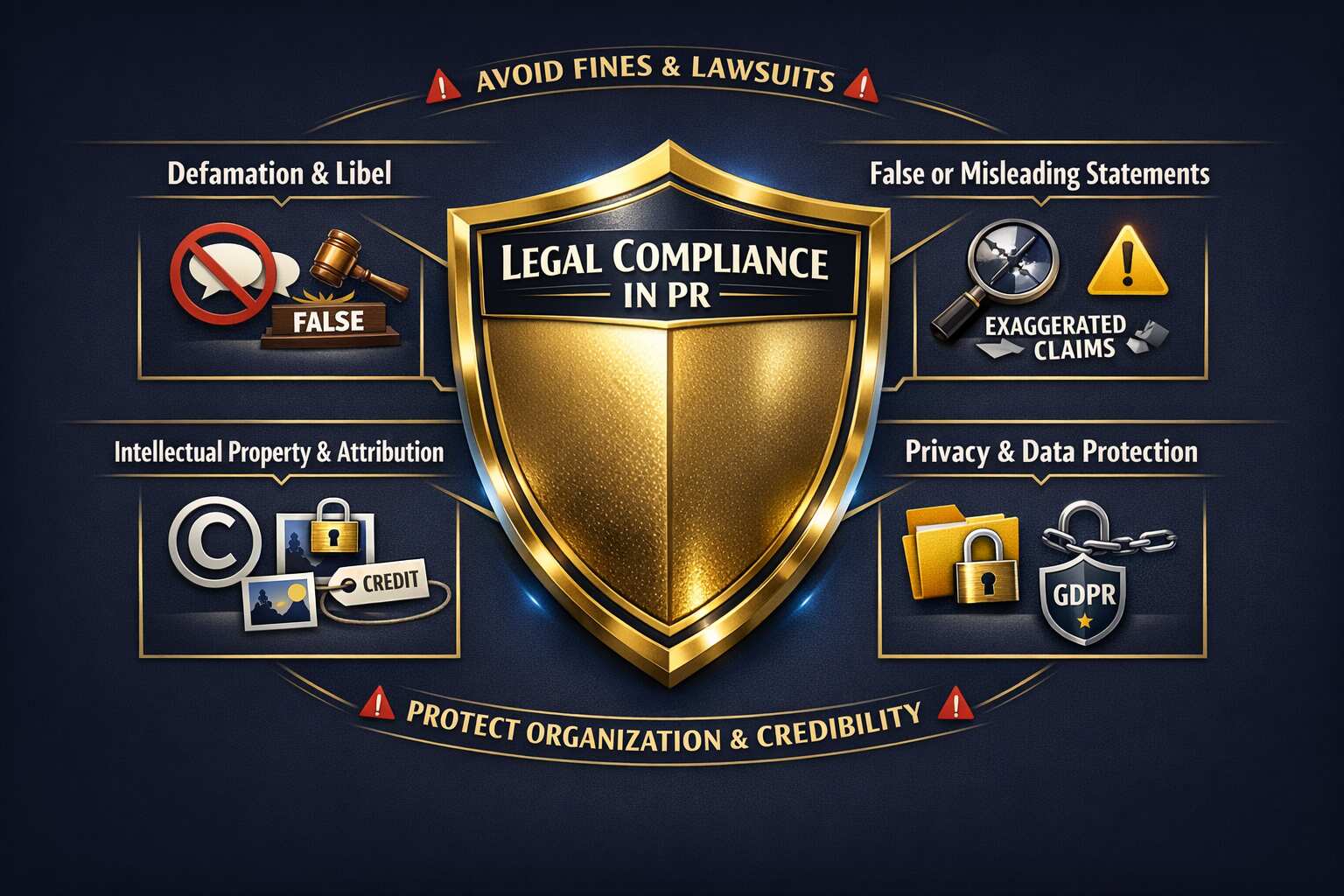
Defamation and Libel
False statements that harm reputations can lead to defamation claims. Press releases and media pitches must be factual and verifiable.
False or Misleading Claims
PR communications must not exaggerate benefits or mislead audiences. Advertising and consumer protection rules apply to press releases.
Intellectual Property Rights
Copyright laws protect images, text, and logos. Proper attribution and licensing are mandatory to avoid legal issues.
Privacy and Data Protection
Journalist and client data must be handled responsibly. Privacy laws require lawful collection, secure storage, and limited use of personal information.
Legal and Ethical Requirements in Press Releases
Press releases are official communications and must meet both ethical and legal standards.
1. Compliance and Review
All press releases should go through a structured review process to verify facts, financial information, and legal risks.
2. Sponsored Content and Paid Media Disclosure
Sponsored or paid press releases must be clearly labeled. Editorial content must remain separate from advertising.
3. Avoiding Misleading Claims
Headlines, body content, and quotes in press release must not exaggerate or distort facts. Ethical PR ensures credibility and informed decision making.
Practical Application for PR Teams and Agencies
In day-to-day professional practice, ethical public relations depends on repeatable systems, not individual judgment alone.
Clear workflows help PR professionals make informed decision making part of routine operations, especially when managing multiple clients, media deadlines, approval chains, and PR influencer marketing campaigns that involve paid partnerships and public disclosures.
Documented processes also help teams provide objective counsel to clients when personal or professional interests could influence communication decisions.
To ensure ethical behavior, PR teams should:
Document ethics and compliance policies
Implement fact-checking and approval workflows
Use disclosure checklists
Maintain consistent professional standards across teams
Applying ethics in daily workflows also supports ethical hiring practices and helps expand professional practices responsibly. When teams align ethical expectations across departments, they are better equipped to deal fairly with clients, encourage responsible client behavior, and manage professional interests without conflict.
Emerging Ethical Challenges in Public Relations
As the public relations profession evolves, PR practitioners must reassess ethical considerations tied to speed, automation, and digital reach. Emerging tools can amplify messages instantly, which increases responsibility for accuracy, disclosure, and safeguarding confidential information.
Ethical challenges now often arise not from intent, but from scale, speed, and lack of review, making responsible decision making more critical than ever.
Modern PR faces new challenges, including:
AI-generated content requiring human oversight
Preventing misinformation and correcting erroneous communications
Ethical crisis communication prioritizing public safety
Transparency across digital and social media platforms
Continued personal professional development allows PR practitioners to build specialized knowledge and adapt ethical public relations strategies to changing media, technology, and regulatory environments.
Measuring Ethical and Legal Compliance
Measuring ethical and legal compliance also supports informed decision making within agencies.
Tracking outcomes helps PR professionals refine their decision making process, identify ethical considerations early, and ensure professional standards are upheld consistently across campaigns, clients, and communication channels.
Agencies should track:
Corrections and errors
Legal incidents or complaints
Disclosure consistency
Journalist trust and feedback
Internal compliance audits
These indicators reflect ethical standards and professional integrity.
Conclusion
Legal and ethical guidelines are essential to ethical public relations. They protect PR professionals, clients, and the public while supporting informed public debate.
Ethical public relations also helps aid informed public debate by ensuring audiences receive accurate, contextual, and responsibly presented information.
By applying ethical principles, ensuring legal compliance, and maintaining transparency, PR professionals strengthen trust, protect reputation, and uphold the standards of the public relations profession.
Frequently Asked Questions
What are the ethical principles of public relations?
The core ethical principles include honesty, accuracy, transparency, fairness, confidentiality, and responsible advocacy. These principles guide PR professionals to communicate truthfully while protecting the public interest.
What is the code of ethics for PR professionals?
A code of ethics outlines professional standards for ethical conduct, disclosure, and conflicts of interest. Common examples include codes from the Public Relations Society of America, IABC, and IPRA.
What legal risks do PR professionals face?
PR professionals may face risks such as defamation, misleading claims, privacy violations, and failure to disclose paid or sponsored content. These risks apply to press releases, media pitches, and public statements.
Why is disclosure important in press releases?
Disclosure ensures transparency by informing audiences when content is paid or sponsored. It protects credibility and helps PR professionals comply with advertising and consumer protection laws.
How does GDPR affect media outreach in PR?
GDPR requires lawful collection, secure storage, and responsible use of journalist and client data. PR teams must use consent or legitimate interest and safeguard confidential information.
How should PR professionals handle incorrect information?
PR professionals should correct erroneous communications promptly and transparently. Taking responsibility for mistakes demonstrates ethical conduct and maintains trust with journalists and the public.
Why is ethical decision making important in public relations?
Ethical decision making helps PR professionals balance client goals with legal limits and public responsibility. It reduces reputational risk and supports long-term credibility.


