
Publishing a book is easier than ever. Getting media coverage for it is not. Journalists are selective, overloaded, and focused on relevance.
Muck Rack’s State of Journalism 2025 shows that 86% of Journalists ignore pitches that don’t match their beat, and 77% now use AI tools to filter and evaluate information faster. That means unclear, unfocused book pitches are dismissed quickly, regardless of quality.
Using Press releases as a core PR strategy allows authors to present their work as a legitimate news story rather than a sales pitch. This guide explains how authors use media announcements strategically to support a book launch, attract authentic coverage, and reach potential readers without relying on hype.
Key Highlights:
A book press release presents a book as a news story journalists can work with.
media releases play a supporting role in book publicity, alongside pitching and outreach.
Journalists look for relevance, timing, and a clear reason to cover a book.
Media attention depends more on positioning than distribution.
Many book media releases fail because the story is unclear or misaligned.
The real value of a book press release shows up in coverage quality and visibility.
What Is a Book Press Release?
A book launch announcement is a short, factual news document written for journalists and editors.
Its role is not direct promotion, but to explain why a new books release is relevant, timely, and worth covering as a story.
Unlike marketing copy, a press release follows a journalistic structure by presenting facts and context clearly so editors can quickly understand the angle and decide whether it fits their coverage.
Why Authors Need Press Releases?
Authors use press releases to give the media a clear, structured overview of their book and its background.
Journalists work under tight deadlines and rely on concise information that fits their editorial process. An official announcement of book launch gives them essential facts, background, and angles in one place, reducing friction and increasing the likelihood of media coverage.
A book media release is most effective when it supports a defined launch moment, such as a release date, pre-order window, or early media push.
Why Most Book Launch Press Releases Fail?
Most book PR fails because they are written without considering how journalists work.
Many read like sales copy, focusing on promotion rather than news value. Others lack a clear angle or are sent to outlets that do not cover the book’s subject at all.
Timing also plays a role, as releases often arrive without any connection to current topics or editorial priorities.
Core Elements of an Effective Book Launch Press Release
A book launch press release works best when it feels easy to read and easy to use. Journalists scan quickly. They want clear facts, a clear angle, and a clear reason to care.
The elements below are what most editors expect to find when deciding whether a book is worth covering.
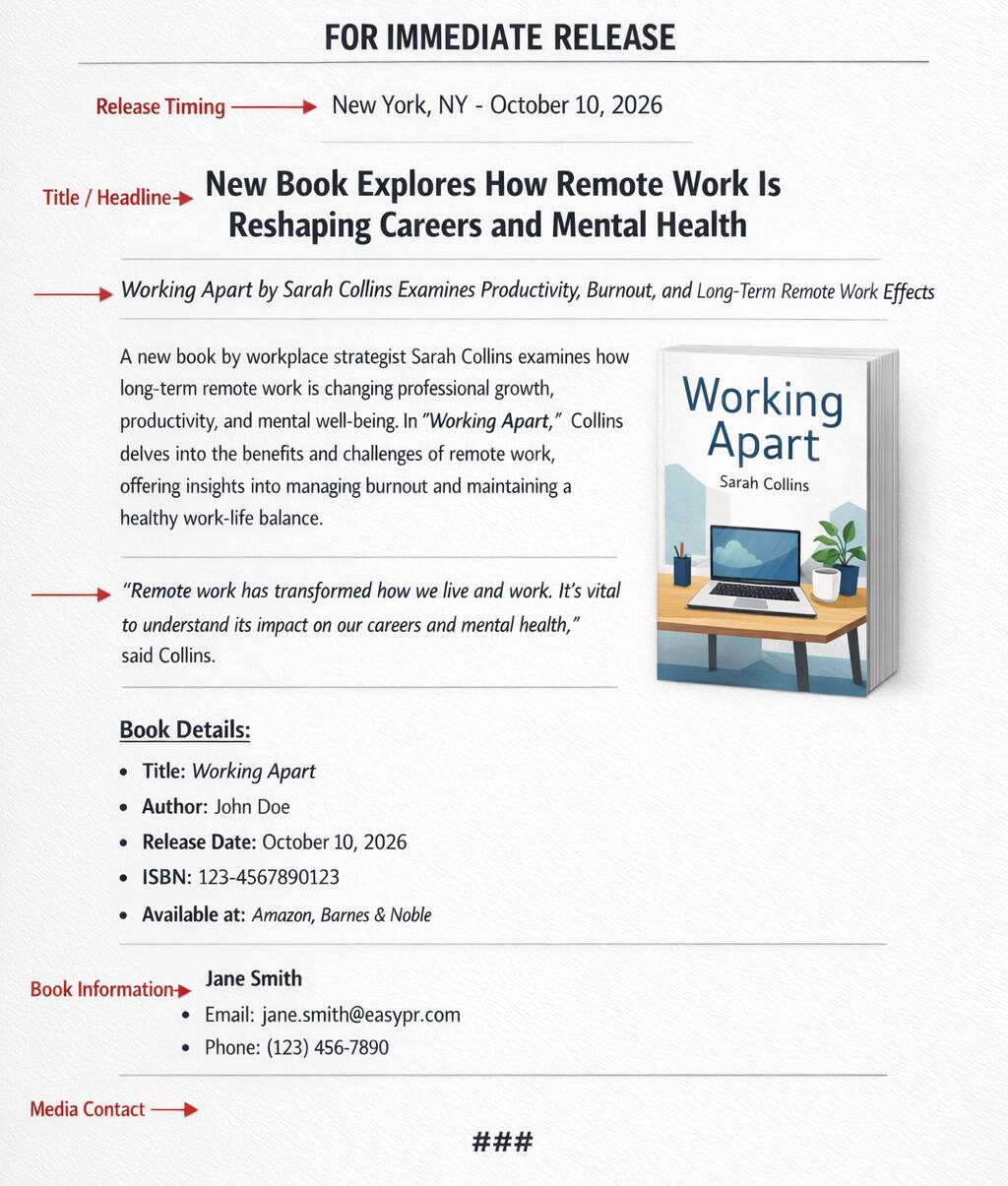
Headline
The headline should state the point clearly. It needs to show what the book is about and why it is relevant. If the headline feels vague or promotional, most editors will stop there.
Dateline and Lead Paragraph
The dateline shows where and when the announcement is coming from. The dateline includes the city, state, and release date.
The lead paragraph answers the basic questions immediately: what the book is, who wrote it, when it launches, and why it matters now.
Newsworthy Angle
This is the reason the press release exists. The angle explains why the book matters now. It could be tied to current events, a growing trend, professional insight, or a personal story that adds context.
Book Summary
The summary gives a clear idea of the book’s focus without trying to sell it. Its goal is to inform and spark interest, not to replicate the book description used on retail platforms.
Author Bio
The author bio explains who the writer is and why their perspective matters. This might include professional experience, research, previous work, or direct involvement with the topic.
Quotes
Quotes add voice and personality. They should sound natural and offer insight or perspective. Promotional or exaggerated quotes are usually ignored.
Essential Details
Include the publication date, ISBN, format, and where the book is available. These details help editors verify information quickly.
Media Contact
Provide a clear media contact with an email address and phone number. Editors need to know who to reach for interviews or clarifications.
Visual Assets and Media Kit Links
High-resolution book covers, author photos, and additional background materials should be available through a media kit link. This makes publishing easier and faster.
How Authors Get Media Attention From Press Releases?
Press releases help create clarity, but they rarely work on their own. Media attention comes from how well the release is used as part of a broader outreach process.
Authors who see PR as a support tool are more likely to earn digital coverage.
1. Building a Targeted Media List
Authors need to focus on people who already cover similar topics. This includes journalists, bloggers, podcasters, and niche publications. A short list of relevant contacts is more useful than a large list that has no connection to the book’s subject.
2. Writing Personalized Pitches
Journalists do not read media releases without context. A short pitch explains why the book fits their audience or beat. It does not repeat the PR. It simply points to the angle that makes the story worth considering.
3. Using a Media Kit Correctly
A media kit keeps everything in one place. It usually includes the PR, author bio, book cover, and contact details. Journalists use it to save time, not to explore extra material.
4. Timing and News Cycles
Journalists are more likely to cover a book when there is a clear reason to talk about it at that moment. If a release arrives without that reason, it is usually ignored.
Free vs Paid Book Launch Press Release Distribution
Press release distribution can support a book launch, but it does not create media interest on its own. Its value depends on the author’s goal, the type of book, and how distribution is combined with direct outreach.
As authors plan their launch timeline, they must determine how often to publish PR to avoid over saturating their target media channels while ensuring consistent visibility. Understanding the difference between free platforms and paid services helps authors choose the right approach for their budget and schedule.
Distribution Type | Examples | What It’s Useful For | Limitations |
Free Book Launch Press Release Sites | PRLog, Online PR Media, IssueWire (free tier), OpenPR | Basic online visibility, search indexing, public launch references | Rarely monitored by journalists; limited editorial impact |
Paid Press Release Distribution Services | Affordable distribution platforms with global and regional targeting (e.g., EasyPRwire) | Broad reach, international or local visibility, credibility signals | Does not replace pitching; coverage still depends on relevance |
When Does Press Release Distribution Help and When It Doesn’t?
Press Release Distribution helps when it supports a clear strategy. When combined with a strong angle, targeted pitching, and relevant timing, it can increase exposure and reinforce outreach efforts. It is especially useful for creating a public record of a book launch and supporting global or local visibility.
PR Distribution falls short when used alone. Sending a media release through any platform, free or paid, without relevance or follow-up rarely leads to meaningful media coverage. Editorial attention still depends on news value, audience fit, and journalist interest.
How to Write a Book Launch Press Release? (Step-by-Step)
Writing a book launch press release is about turning a book into a clear, usable news story.
Each step builds on the previous one, helping journalists quickly understand what the book is about and why it is relevant
Step 1: Define the Media Angle
Before writing anything, decide why the book matters now. This is the story hook, not the book description.
For example, a book on personal finance may be timely if it addresses rising living costs or new economic trends. Without a clear angle, the PR reads like a generic announcement.
Step 2: Write the Inverted-Pyramid Lead
The opening paragraph should deliver the most important information immediately. Editors should understand the story without scrolling.
A strong lead answers: what the book is, who wrote it, when it launches, and why it is relevant at this moment.
Step 3: Build Credibility Fast
Journalists need to know why this author is worth paying attention to. Credibility should appear near the top, not buried at the end.
This could include professional experience, research background, industry involvement, or lived experience directly related to the book’s subject.
Step 4: Add Quotes and Context
Quotes give the press release a human voice. They should explain ideas, opinions, or motivations behind the book, not promote it.
For example, an author quote might highlight the problem the book addresses or the insight that led them to write it.
Step 5: Format for Journalists
Structure matters. Use short paragraphs, clear spacing, and a third-person tone. Avoid long blocks of text or marketing language.
A clean layout makes the release easier to scan and easier to use in an article.
Step 6: Final Review Before Sending
Before sharing the PR, check all facts carefully. Confirm names, dates, links, ISBN numbers, and contact details.
Small errors reduce trust and can stop coverage before it starts.
Book Launch Press Release Examples and Templates
This section shows what a book launch press release actually looks like in practice. The goal is not to copy it word for word, but to understand how structure, angle, and clarity work together.
What to Avoid in a Book Press Release?
Many authors put time into writing a press release but still see no response. The problem is not the book or even the writing quality. It is how the media release is positioned, shared, and expected to perform.
These are the most common issues that quietly block media interest.
1. Over-promotion: When you’re close to your book, it’s easy to highlight how great it is. But journalists are not looking for praise or selling points. If the release reads like marketing copy, it feels less like a story and more like a promotion, which usually gets skipped.
2. Poor targeting: Reaching out to everyone may seem like a good idea, but it often works against you. When a book does not match what an outlet normally covers, the message is ignored. Focusing on relevance leads to better responses than chasing reach.
3. Awkward follow-ups: Many authors either hesitate to follow up or send too many reminders. Both can hurt results. A single, polite follow-up after a reasonable gap is usually enough to show interest without creating pressure.
4. Unrealistic expectations: Publishing or distributing a PR does not mean media coverage will follow. Editors decide what to cover based on timing, audience interest, and editorial priorities. Treating coverage as an opportunity rather than an expectation keeps outreach realistic and effective.
Measuring the Success of a Book Launch Press Release
Success is not only about how many times a press release is published. For authors, it shows up in how the book is talked about, where it appears, and whether it continues to surface over time.
1. Media mentions
Look at which outlets mention the book and how it is presented. Coverage that explains the book’s idea, includes quotes, or highlights the author’s expertise is more valuable than brief or generic mentions.
2. Backlinks and authority
When media outlets link to the book or the author’s website, it improves discoverability and credibility. These links help search engines understand the book as a trusted reference, not just a one-time announcement.
3. Referral traffic
Traffic coming from media coverage shows whether readers are interested enough to learn more. This can include visits to the author’s site, book pages, or related content following publication.
4. Long-term visibility
Some press coverage continues to appear in search results months after a launch. Articles, interviews, and features can keep bringing attention to a book well beyond its release window.
Conclusion
A book press release helps journalists understand what a book is about and why it may be worth covering. It supports media outreach by presenting clear information, but it does not create coverage on its own.
Authors who gain media attention focus on relevance, timing, and editorial fit rather than promotion. When a PR is used alongside targeted outreach, it becomes more effective and easier for journalists to work with.
Used thoughtfully, a book PR strengthens visibility and credibility over time. It works best as part of a broader publicity effort, not as a one-time solution.
Frequently Asked Questions
What is the best time to send out a book press release?
The best time is when the book connects to something timely, such as a current topic, seasonal theme, or ongoing discussion. Relevance matters more than a specific day or hour.
What is the difference between a book press release and a media kit?
A book press release is a single news document explaining the book and its angle. A media kit includes supporting materials like the release, author bio, images, and contact details.
Do indie authors need press releases?
Indie authors benefit from PR when their book has a clear angle, expertise, or relevance that media outlets may want to cover.
Are press release distribution services worth it for book launches?
Distribution services can help with visibility and reach, but they do not replace targeted pitching or direct media outreach.
Can AI write book press releases effectively?
AI can help with structure and drafting, but strong angles, relevance, and editorial judgment still require human input.
How do book press releases differ from brand or product releases?
Book press releases focus on ideas, insight, and relevance rather than features or pricing. Editorial interest depends more on the author’s credibility and how the book connects to current conversations.
When to Use a Press Release During a Book Launch?
Authors typically use PR at specific points in a book launch. Before launch, a digital announcement helps introduce the book and its angle. At launch, they support release-day coverage and media outreach. After launch, they can extend visibility through features or interviews.


